The Protect College Sports Act cleared its first floor test on Tuesday. The Senate voted 74-24 to invoke cloture on the motion to proceed to S. 4668, clearing the 60-vote threshold needed to move the bill toward debate and, eventually, a final up-or-down vote. It is the furthest this legislation, or its predecessor, the SCORE Act, has advanced in either chamber.
It is also not passage. Cloture ends debate on whether to take the bill up at all. The Senate still has to work through amendments, then hold a separate vote to pass the bill itself, before it goes to the House, where a comparable bill already failed earlier this year. Majority Leader John Thune has not committed to a timeline beyond getting a vote before the Senate’s pre-election recess.
Tuesday’s vote gave something the last four months of letters and statements could not: an actual roll call. The SWAC and Texas Southern’s president backed the bill in June. The MEAC backed it too, with reservations. The Congressional Black Caucus said no in August, the same day UNCF said yes. Tuesday turned those positions into votes, and added a new one: for the first time in this bill’s history, a student-athlete stood next to its lead sponsor and asked Congress to pass it.
What the Vote Actually Did
Cloture on a motion to proceed is a procedural gate, not a verdict on the bill’s contents. A “yes” vote means a senator is willing to let the Senate begin debating and amending S. 4668. It does not commit that senator to voting for final passage, and several senators who support parts of the bill but want it changed voted yes anyway simply to get it to the floor. The tally:
| Roll Call Vote 235, Sept. 15, 2026 | Count |
|---|---|
| Yea (cloture invoked) | 74 |
| Nay | 24 |
| Not voting | 2 |
| Threshold required | 60 |
With cloture invoked, the bill is now formally before the Senate. Ranking Member Maria Cantwell of Washington, the bill’s Democratic co-author, called the outcome a chance to “bring some sanity” to college sports and said the legislation “will put revenue sharing into law for the first time.” She said she was cautiously optimistic about the bill’s chances in the House, where the earlier SCORE Act stalled.
Every Black Senate Democrat Voted No
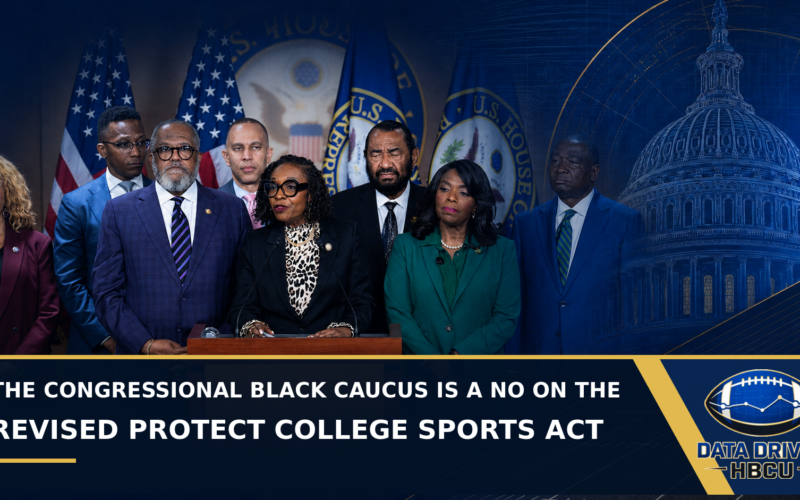
The 24 no votes included, as The Associated Press reported, all four Black members of the Senate Democratic caucus: Cory Booker of New Jersey, Raphael Warnock of Georgia, Lisa Blunt Rochester of Delaware, and Angela Alsobrooks of Maryland. None of the four issued a floor statement explaining the vote individually, but the alignment matches the position the Congressional Black Caucus staked out in writing five weeks earlier, when it said it “cannot support advancing the Protect College Sports Act in its current form” and closed its statement with “nothing about us without us.” Tuesday’s vote is the first time that position showed up as an actual no, cast by name, rather than a letter signed by a caucus.
The caucus’s argument, as this site covered in August, was never that the bill contains nothing for HBCUs. Title III, the HBCU Sports Media and Connectivity Program added in the August revision, authorizes up to $180 million a year for HBCU broadband and sports broadcast infrastructure. The caucus objected to who wrote the rules, not what they contain, arguing that Black athletes, coaches, agents, and HBCUs were not meaningfully at the table while the bill was drafted. Four no votes from the Senate’s Black Democrats do not sink the bill on their own. Cloture cleared by 14 votes over the threshold. But they mark exactly which senators the bill’s supporters have not persuaded, even after a summer of revisions aimed partly at HBCUs.
The NAACP Is Making the Same Argument It Made in August, on National TV
The NAACP’s pushback this week began before the vote, on X. On Saturday, Sept. 12, Cruz appeared on ESPN’s College GameDay to promote the bill and, according to coverage, was met with sustained boos from the crowd. The NAACP needled the network for the platform and, invoking Johnson’s home state, dared ESPN to give him equal time:
Surprised @espn so willing lent their platform to political performance today. But we’ll play. We’d love to have @DerrickNAACP join you in his home state of Miss. next week to express why the Protect College Sports Act is dangerous to Black Athletes and the Black community. 🤷🏾♂️ https://t.co/jzZa6rwyq3
— NAACP (@NAACP) September 12, 2026
Two days later, on Monday, the NAACP was back on the same platform with its core objection to the bill’s substance, the same argument the organization has made since the SCORE Act debate in the spring: that the bill weakens athletes’ ability to organize on their own behalf.
Don’t believe the hype. The #ProtectCollegeSportsAct would make it harder for student-athletes to organize, bargain collectively, and fight for fair treatment. Real protection means empowering athletes, not silencing them. Powerful institutions don’t get to profit off the backs… https://t.co/ESe8Vqr27C
— NAACP (@NAACP) September 14, 2026
Three days after the GameDay exchange, ESPN put Johnson himself on the air. He appeared on SportsCenter the afternoon of the vote and repeated, almost point for point, the objection this site has tracked since the CBC’s June letter: that decades of NCAA rule-making have not gotten college sports right, and that a federal antitrust exemption would lock in that record rather than fix it.
“You think about 1979, when the Eric Dickerson incident happened. College sports didn’t get it right. That’s 47 years of not getting it right,” Johnson said. “And what makes anyone think they’re going to get it right this time? It takes away athletes’ rights. It creates an opportunity for the sports league to commit what would now be illegal acts because they will have exemption from antitrust legislation.”
Asked what protections for HBCUs are missing from the bill, Johnson went directly at Title III, the same provision the Congressional Black Caucus’s August statement never mentioned by name. Johnson did.
“I’m not fooled by the head fake of putting in the HBCUs at the last minute,” Johnson said. “It is a payout over several years. It is an authorization, but not an appropriation. That’s two different things. And at the end of the day, we should not be tokenizing our historically Black colleges and universities in order for the major college universities to generate $14 billion in revenue annually.”
That distinction, authorization versus appropriation, is the same caveat this site raised when Title III was first added to the bill in August: Congress authorizing $180 million a year does not put $180 million a year into the program. Appropriators still have to fund it year by year after the bill becomes law, and the grant program cannot accept applications until federal agencies publish criteria after a public comment period. Johnson’s SportsCenter appearance is the most prominent national platform that argument has had since.
Johnson also rejected the bill’s central stability pitch. “Who says there’s instability?” he said. “You have coaches that have been doing this for decades now, and unfortunately the players did not have the same rights. Now that players have rights, they’re saying it’s unstable. There’s nothing unstable with students being able to collectively bargain.”
Athletes.org’s Case Got More Specific, Not Softer
Athletes.org, the players’ advocacy group that has opposed both the SCORE Act and the Protect College Sports Act since May, published a seven-point rebuttal to the bill the day before the vote. Two of its arguments speak directly to what has and has not changed for HBCUs since this site’s last update.
On the money, Athletes.org made the same authorization-versus-appropriation point Johnson made on air, tied to the specific section number in the current floor text. The group wrote that the HBCU grant program “authorizes up to $180 million annually from fiscal years 2027 through 2032, for a potential total of $1.08 billion,” but “does not actually appropriate a single dollar,” and argued that “potential HBCU funding should not be used as a bargaining chip to make an unrelated, permanent antitrust exemption more politically acceptable.” That figure, and the authorization gap behind it, match this site’s own reporting on Title III almost exactly.
On oversight, the group targeted the bill’s ombudsman office, created to field athlete complaints against the NCAA, conferences, and schools. Athletes.org noted the office would be funded by the same intercollegiate athletics system athletes might need protection from, lacks independent subpoena power, and cannot compel corrective action, impose sanctions, or award damages. “Confidential support is not independent oversight,” the group wrote. “Athletes deserve both.”
The group also raised a case this site has not previously covered: the November 2024 death of Alabama A&M linebacker Medrick Burnett Jr., who suffered a severe head injury on a kickoff return during the Magic City Classic and died days later. Athletes.org used the case to argue the NCAA has been slow on player safety, noting that the NFL redesigned its kickoff rule before that season specifically to reduce high-speed collisions, while the NCAA kept its existing rule. The bill does not address kickoff safety rules directly. Athletes.org’s point was broader: that the same institutions the bill would shield from antitrust liability have a mixed record on protecting the athletes inside that shield.
Not Every HBCU Athlete Agrees With the NAACP
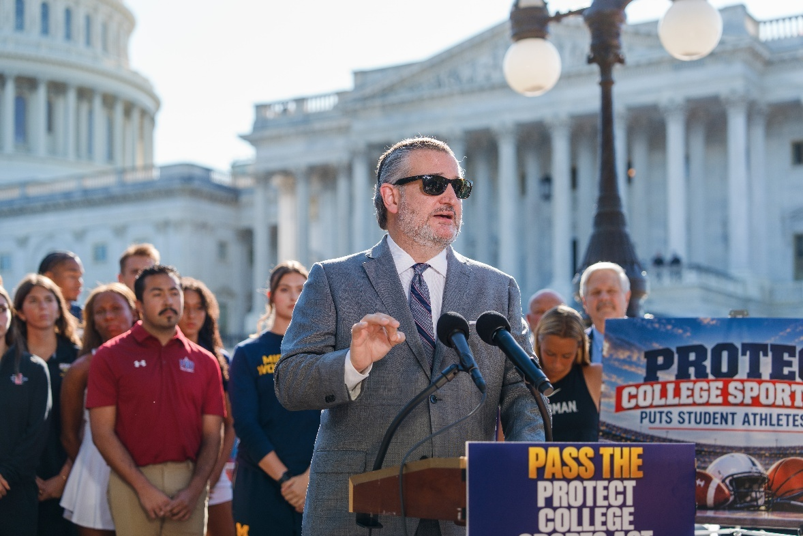
The day before the vote, Senate Commerce Chairman Ted Cruz held a press conference with more than 30 student-athletes and coaches from around the country, as part of a final push to move the bill before the Senate’s pre-election recess. One of them wore Howard University colors.
Kedrick Green, a football player for the Bison, spoke in support of the bill on camera at the event. “As a college student, I believe the Protect College Sports Act is about giving student athletes like me something we all deserve: security and a fair opportunity,” Green said. “It protects our right to earn from our name, image, and likeness, while putting safeguards in place so athletes aren’t taken advantage of. It protects scholarships, strengthens health and safety standards, and creates more consistent rules around NIL, transfers, and eligibility for HBCU students like myself at Howard University and conferences like the MEAC.”
Senate Commerce Republicans posted video of the remarks on X the day of the vote:
Student athletes should be able to trust that the system they compete in will protect their future.
“The Protect College Sports Act is about giving student athletes like me something we all deserve — security and a fair opportunity.” Kedrick Green, @HowardU @HUBISONFOOTBALL pic.twitter.com/f77vmjCVb7
— Senate Commerce Republicans (@SenateCommerce) September 15, 2026
Additional footage from the press conference, including Green’s full remarks, is posted below:
Green tied the case directly to conference-level stability, the same argument Texas Southern President James W. Crawford III and SWAC Commissioner Charles McClelland made in June. “Stability matters,” Green said. “We need a system that gives us an opportunity to compete and grow, not one where the rules constantly change depending on where you play.”
Green’s appearance does not resolve the split this site has tracked since June. It complicates it. The NAACP and the Congressional Black Caucus are arguing the bill’s process failed Black athletes specifically. A Black athlete at an HBCU, standing at a podium next to the bill’s lead sponsor, is arguing the opposite: that the bill’s rules on NIL, transfers, and eligibility are exactly the security his conference needs. Both things are now part of the public record on the same day.
The Coalition Keeps Growing
The bill’s supporter list has kept growing since this site’s last count. The Senate Commerce Committee now puts the coalition at 29 collegiate athletic conferences and more than 370 colleges and universities across all 50 states and Washington, D.C., including HBCUs, up from 28 conferences and roughly the same school count in August. New endorsements since then include the NFL, MLB, the NHL, the NBA, the NFL and NBA players’ associations, the U.S. Olympic and Paralympic Committee, and Team USA’s Athletes’ Commission.
Senators John Hoeven of North Dakota and Ben Ray Luján of New Mexico signed on as cosponsors ahead of Tuesday’s vote, joining Eric Schmitt, Chris Coons, Shelley Moore Capito, Peter Welch, Pete Ricketts, and John Hickenlooper. Hoeven framed his support around the same competitive-imbalance argument HBCU leaders have made all year. “Across the country, small athletic programs are disappearing, student athletes are left vulnerable to exploitative contracts, and college rosters are being hollowed out by a system that awards excessive transfers,” Hoeven said.
The White House has also formally weighed in. In a Statement of Administration Policy, the administration said it “fully supports passage” of the bill, citing “significant legal and financial uncertainty” and “endless litigation” threatening the future of college sports, particularly Olympic and non-revenue programs. The statement indicates the president would sign the bill if it reaches his desk, consistent with Cruz’s public hope that a signing could happen this fall.
Where Things Stand
| Voice | Position as of Sept. 16 |
|---|---|
| SWAC | Supports, sent letter of endorsement in June |
| MEAC | Supports with reservations, wants employee status addressed |
| UNCF | Supports, endorsed in August alongside a debt forgiveness ask |
| Congressional Black Caucus | Opposes in current form, four members’ Senate votes matched the position Tuesday |
| NAACP | Opposes, repeated its case on national television Tuesday |
| Athletes.org | Opposes, published expanded rebuttal the day before the vote |
| Individual HBCU athletes | Mixed; at least one, Howard’s Kedrick Green, has spoken in support on camera |
The bill now moves into floor debate, where amendments are possible before a final passage vote. Cruz wants that vote before the Senate leaves for its pre-election recess. If the Senate passes the bill, it goes to the House, where a similar effort collapsed earlier this year under many of the same objections raised again this week. Nothing about the HBCU-specific provisions, Title III’s funding structure, the employee-status language the MEAC has asked Congress to resolve, or the antitrust exemption the NAACP and Athletes.org both oppose changed in Tuesday’s vote. What changed is that the positions this site has tracked since May are now attached to actual votes, actual television appearances, and, for the first time, an HBCU athlete’s name on the list of people asking Congress to pass it.
Data Driven HBCU has covered the Protect College Sports Act’s implications for HBCU athletics since the bill’s introduction. Prior coverage in this series: HBCU backing and early opposition in June, MEAC Commissioner Sonja Stills on employee status in July, the revised bill’s HBCU title in August, and the Congressional Black Caucus’s no and UNCF’s yes, also in August.