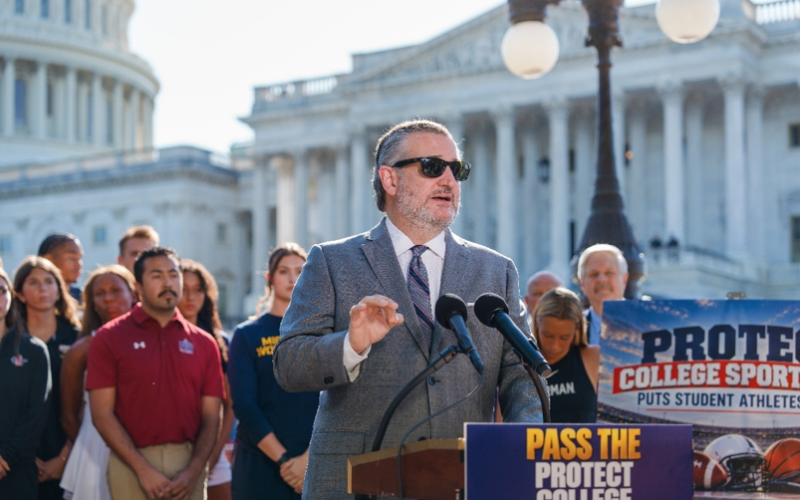

Two weeks ago, four HBCU conference commissioners wrote Congress endorsing a House bill called the SCORE Act. That bill is dead. The House pulled it from consideration last week, and on May 27, 2026, the Senate Commerce Committee put a replacement on the table: the Protect College Sports Act of 2026, a bipartisan agreement between Chairman Ted Cruz of Texas, Ranking Member Maria Cantwell of Washington, and cosponsors Eric Schmitt of Missouri and Chris Coons of Delaware. A committee hearing has not been scheduled. The bill has not reached the Senate floor. College sports legislation is, once again, starting over.
Neither HBC4us nor any of the four conferences that publicly endorsed the SCORE Act has issued a word about the Senate bill, which means nobody has answered the question on behalf of those programs: is this one actually better for HBCU athletes? We read both bills against the FY2025 financial data for the 23-school Division I HBCU cohort. The answer is yes in three specific ways, and the structural problems that defined the original critique are still there, unchanged, as if nobody noticed them.
What Changed
The most significant difference between the two bills is a single sentence. Section 122 of the PCSA reads: “This title is neutral on, and does nothing to alter, employee or non-employee status for student athletes.” Seventeen words. Compare that to Section 8 of the SCORE Act, which explicitly prohibited any court, labor board, or federal agency from classifying college athletes as employees. The SCORE Act did not sidestep the employment question. It answered it by statute and moved on, before any court could weigh in.
Several federal cases are currently working through the courts arguing that college athletes qualify as employees under labor law. Employee status matters because it is the legal gateway to collective bargaining, to filing unfair labor practice claims, to having a seat at the table when compensation terms are being set rather than just being handed them. If the SCORE Act had passed with Section 8 intact, those cases would have been rendered moot by an act of Congress. Under the PCSA, they remain live. Whether athletes will ultimately prevail in court is a separate question entirely. The point is that the Senate bill does not foreclose the answer before anyone has had a chance to find out.
The second meaningful difference is Section 106, the post-eligibility medical trust fund. The SCORE Act had nothing like it. The PCSA directs the NCAA to maintain a fund of at least $60 million to cover post-eligibility medical obligations for athletes at Division I schools generating less than $20 million in total annual athletics revenue, along with coverage for long-term conditions including CTE and cognitive impairment across all Division I programs regardless of revenue.
The $20 million line was drawn to capture the universe of smaller Division I programs, and HBCU athletic programs, taken as a whole, are close to that universe. But the 2024-25 EADA federal filings for all 23 schools reveal a wrinkle the MFRS data alone does not capture: four schools in the cohort report total revenue above $20 million. Howard University leads at $26.3 million, followed by Norfolk State at $24.8 million, Morgan State at $23.6 million, and NC A&T at $23.0 million. All four are currently above the threshold on paper, which means their post-eligibility medical coverage would not be covered under Section 106’s hardship provision as written. Three of the four are MEAC schools. The remaining 19 schools in the cohort sit clearly below the line.
NC A&T’s figure carries an additional caveat: the university’s 2024-25 EADA filing is marked as amended, and the reported total revenue reflects adjustments made after the original submission. Its actual eligibility under Section 106 depends on both the amended figures and how the bill’s “total annual athletics revenue” language is ultimately interpreted. Whether that definition tracks EADA reporting categories or applies a narrower earned-revenue definition is not specified in the bill text.
The harder question is what $60 million actually covers. The 23-school HBCU cohort alone accounts for 8,012 athletes. Hundreds of additional programs at comparable budget levels would qualify nationwide. The fund is a floor, not a ceiling, and the bill does not specify how it gets allocated across schools or how claims are adjudicated. Congress wrote the minimum into law and handed the actuarial math to the NCAA. That detail will matter enormously when the fund actually pays out.
The third difference is Section 111, which requires student-athlete representation on the governing bodies that write the rules athletes compete under. Under current NCAA governance, athletes sit on advisory committees. They are consulted. Section 111 gives them a vote on the bodies that actually decide. How much that vote translates into real leverage will depend on how the covered entity structures its governance, but it is a change the SCORE Act never proposed.
What Did Not Change
The revenue pool carries over from the SCORE Act with its architecture intact, including the two provisions that disadvantage every school in this cohort.
The distribution formula runs three tiers, and the middle one is where the problem sits. Tier A sets a guaranteed minimum by unanimous vote of the covered entity’s members. Tier C distributes based on performance. Tier B takes 15 percent of the remaining pool and splits it equally among Football Bowl Subdivision institutions that had football revenue in the prior year. Every football-playing school in the 23-school HBCU cohort competes in the Football Championship Subdivision. None are FBS programs. The equal-distribution tier, the one that requires no negotiation and no performance, is not available to any of them. That is not an oversight in the drafting. It is a structural exclusion written into the formula.
The earned revenue problem runs alongside it, just as unchanged. Across the 16 schools with FY2025 MFRS filings, 73.9 percent of total athletic revenue came from institutional support and student fees. The PCSA builds its distribution pool from ticket sales, media rights, conference and NCAA distributions, sponsorships, and competition guarantees. Institutional support does not count. Student fees do not count. Programs that depend on those streams to keep their operations running are structurally disadvantaged in any formula that ignores them, and the PCSA ignores them in exactly the same way the SCORE Act did.
The Broadcast Question
Section 204 creates a local broadcast access requirement that, for HBCU fans specifically, could be the most consequential provision in the entire bill. There is a condition, and it is a real one.
Under Section 204, any school whose conference joins the covered entity’s media rights pool must make at least one football game and at least one basketball game per season available at no cost through a local broadcast outlet. The FCC would define the covered market areas within 180 days of enactment and holds enforcement jurisdiction. Noncompliance lands with the FCC, not with the conference.
The condition is that conferences have to join voluntarily. Participation is explicitly optional under Section 5(i) of the bill, and SWAC, MEAC, OVC, and CAA would each have to decide independently whether the economics make sense for their programs. That calculation turns on the Tier A guaranteed minimum, a number that will be set by unanimous vote of the covered entity’s members after the entity is formed. Right now, that number does not exist because the entity does not exist.
What is not conditional is the problem the provision is built to solve. A grandfather in Itta Bena, Mississippi, who wants to watch Valley State play on a Saturday cannot easily do it if the game is behind a FloSports paywall. A recruit’s family in Baton Rouge should not have to subscribe to ESPN+ to watch Southern University compete. For programs trying to hold their fan bases and recruit in their own backyards, the paywall is not an inconvenience. It is a structural drag on visibility, attendance, and the kind of community connection that eventually shows up as donor support. Section 204 creates the federal architecture for a fix. Whether the SWAC and MEAC commissioners, who endorsed a bill with no broadcast provision at all, decide that joining is worth pursuing is the question they have not yet answered publicly.
The Direct Comparison
Employee Status (Sec. 122)
SCORE Act: Prohibited by statute. Courts and labor boards explicitly barred from classifying athletes as employees.
PCSA: Neutral. Does not alter existing employee or non-employee status.
HBCU Cohort: Ongoing federal employee-status cases remain actionable under the PCSA. The SCORE Act would have resolved them by statute.
Post-Eligibility Medical Fund (Sec. 106)
SCORE Act: No equivalent provision.
PCSA: $60M minimum fund for post-eligibility coverage. Qualifying threshold: less than $20M in total annual athletics revenue.
HBCU Cohort: 19 of 23 cohort schools report total revenue below $20M in 2024-25 EADA filings. Four do not: Howard ($26.3M), Norfolk State ($24.8M), Morgan State ($23.6M), and NC A&T ($23.0M). NC A&T’s filing is marked amended; its figures reflect post-submission adjustments.
Student-Athlete Governing Board Representation (Sec. 111)
SCORE Act: No equivalent provision.
PCSA: Formal voting seat on governing bodies.
HBCU Cohort: Under current NCAA governance, student-athletes hold advisory roles. The PCSA creates a voting seat. The SCORE Act contained no equivalent.
Local Broadcast Access (Sec. 204)
SCORE Act: No equivalent provision.
PCSA: At least one football game and one basketball game per season must be available at no cost through a local outlet, if the school’s conference joins the covered entity.
HBCU Cohort: Applies only if SWAC, MEAC, OVC, or CAA join the covered entity voluntarily under Sec. 5(i). The SCORE Act contained no broadcast access requirement.
Conference Consolidation Limits (Sec. 205)
SCORE Act: No equivalent provision.
PCSA: Conferences generating over $1B in annual revenue barred from absorbing smaller conferences.
HBCU Cohort: No school in the cohort competes in a conference generating over $1B annually. SWAC, MEAC, OVC, and CAA would be on the receiving end of any blocked consolidation. The SCORE Act contained no equivalent provision.
Pool Math: Tier B Equal Distribution
SCORE Act: Revenue pool benchmarked to top 70 earned-revenue schools.
PCSA: Tier B distributes 15% of the pool equally among FBS institutions with football revenue in the prior year. Tier A and Tier C are available to all member schools.
HBCU Cohort: No school in the cohort competes in FBS. All 21 football-playing schools in the cohort are FCS programs. Tier B equal distribution is not available to any of them under either bill’s structure.
Institutional Dependency Exclusion
SCORE Act: Institutional support and student fees excluded from the “college sports revenue” definition.
PCSA: Same exclusion. Pool is built from earned revenue: ticket sales, media rights, conference distributions, sponsorships, and guarantees.
HBCU Cohort: Across the 16 schools with FY2025 MFRS filings, 73.9% of total athletic revenue came from institutional support and student fees. Neither bill counts those funds toward pool calculations or distribution eligibility.
Coaching Transition Rules (Sec. 110)
SCORE Act: No equivalent provision.
PCSA: Sec. 110(e) explicitly limits the provision to FBS programs.
HBCU Cohort: No school in the cohort competes in FBS. The provision does not apply to any of the 23 schools.
Source: SCORE Act (H.R. 4312) as reported by House Rules Committee, May 11, 2026; PCSA bill text as released by Senate Commerce Committee, May 27, 2026; 2024-25 EADA federal filings for all 23 cohort schools via Data Driven HBCU; FY2025 NCAA MFRS filings for 16-school MFRS cohort. NC A&T EADA data reflects an amended filing.
The Commission
Near the end of Title I, past the eligibility rules and medical provisions that have dominated the coverage, is the provision that may ultimately matter most for programs like the ones in this cohort. Section 116 creates a 20-member Congressional Commission on the Future of College Athletics, appointed jointly by the chairs and ranking members of the relevant committees, required to complete its work within five years of enactment, hold public hearings, and submit a formal recommendation to Congress on whether to raise, lower, or eliminate the revenue-sharing cap.
Congress has never before written a mandatory review mechanism into college sports legislation. Every framework that has governed college athletics, including the NCAA’s own governance structures, has operated without any statutory obligation to come back and report on whether the rules are actually working. The Commission changes that. It is the first formal venue where the structural arguments about FCS exclusion, institutional dependency, and smaller-program disadvantage can be placed in front of people with the authority to act on them.
The pool math problems that put this cohort at a structural disadvantage are not locked in permanently by the PCSA. They are specifically within the Commission’s review mandate. That five-year window is only useful if someone shows up prepared to argue for specific changes with specific evidence. The 73.9 percent institutional dependency rate, the FCS composition of every football-playing school in this cohort, the $20 million revenue gap between the smallest school in the Tier B eligibility pool and the largest school in this one. Those are not the ingredients of a general complaint. They are the ingredients of a precise argument, and the Commission is where that argument needs to land.
The Senate Commerce Committee has not yet announced a hearing date. For the SWAC and MEAC commissioners who put their names on a letter endorsing the House bill, the Senate process is still open. So is the question of whether OVC and CAA, whose member programs are in the same cohort and face the same structural constraints, engage the process at all. The question for all of them is whether they show up on behalf of the athletes competing in their programs, or whether the letter they already wrote is the extent of it.
Data Driven HBCU covers the financial reality of public HBCU athletics using publicly available federal filings and NCAA data. All MFRS figures are drawn from FY2025 NCAA Membership Financial Reporting System filings. All PCSA analysis is based on bill text released May 27, 2026, by the Senate Commerce Committee. The prior article in this series can be read here.
Sources
Protect College Sports Act of 2026, S.____ (119th Cong., 2d Sess.), introduced May 27, 2026. Senate Commerce Committee. Bill text.
Cruz, Cantwell, Schmitt, Coons. “Cruz, Cantwell, Schmitt, Coons Strike Agreement to Save College Sports.” Senate Commerce Committee press release, May 27, 2026. Senate Commerce Committee.
H.R. 4312, Student Compensation, Opportunity, Resources and Equity Act (SCORE Act), House Rules Committee Print 119-29, May 11, 2026.
FY2025 NCAA Membership Financial Reporting System (MFRS) filings for 16 public Division I HBCU institutions, compiled by Data Driven HBCU.
Data Driven HBCU. “Four HBCU Conferences Wrote Congress But Their Student-Athletes Weren’t in the Room.” May 13, 2026. datadrivenhbcu.com.