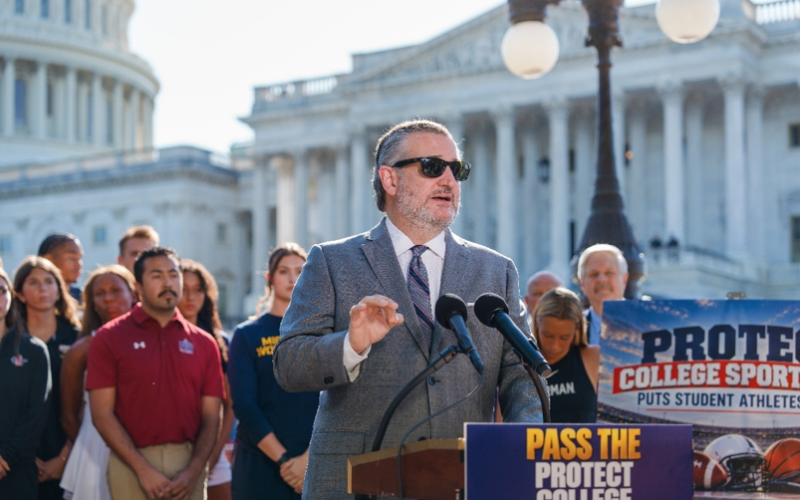

On May 11, 2026, the commissioners of the Central Intercollegiate Athletic Association (CIAA), Mid-Eastern Athletic Conference (MEAC), Southern Intercollegiate Athletic Conference (SIAC), and Southwestern Athletic Conference (SWAC) sent a joint letter to Chairwoman Yvette Clarke and members of the Congressional Black Caucus, urging support for H.R. 4312, the Student Compensation, Opportunity, Resources and Equity Act. Known as the SCORE Act, the bill reached the House Rules Committee that same day and represents the most significant congressional attempt yet to establish a national framework for college athlete compensation. The four conferences that represent nearly every public Division I HBCU in the country put their institutional weight behind it. That endorsement deserves a closer look because the interests of an athletic department and those of the student-athletes within it do not always point in the same direction.
What the Commissioners Are Asking For
The joint letter, signed under the HBC4us coalition name, identified three reasons the four conferences support the bill. First, a federal law would replace the existing patchwork of state name, image, and likeness (NIL) statutes, giving every school, including HBCUs, a single set of rules to operate under. Second, the bill’s compensation structure routes payments through an institutionally managed pool rather than through open-market bidding, limiting how much deep-pocketed boosters at rival programs can spend to attract recruits. Third, federal preemption would prevent any individual state from granting its in-state schools a recruiting advantage over institutions elsewhere.
Each argument reflects a genuine challenge for HBCU programs. The current NIL environment rewards programs with the largest donor networks, and HBCU athletic departments generally cannot match the booster infrastructure of major conference schools, let alone that of better-resourced mid-majors. A pool-based model would, in theory, reduce how much any single school can use direct compensation as a recruiting lever. For administrators trying to compete on limited budgets, a federal cap on that spending has appeal.
The letter’s three arguments share a common thread: each one makes things easier to manage for athletic departments. The question is what they mean for the athletes.
The Financial Picture the Data Reveals
Data Driven HBCU tracks FY2025 filings from the NCAA Membership Financial Reporting System (MFRS) for 16 public Division I HBCUs. Those filings show a financial structure that shapes how the SCORE Act would actually function for these programs.
Across all 16 schools, total athletic revenue in FY2025 was $218.8 million. Of that, $57.2 million (26.1 percent) came from what the SCORE Act defines as “college sports revenue”: ticket sales, competition guarantees, media rights, conference and NCAA distributions, and sponsorships. The remaining 73.9 percent came from institutional support and student fees, two categories explicitly excluded from the bill’s definition. For most HBCU programs, the revenue that matters most for operations does not count at all in the bill’s compensation calculation.
That distinction matters because the compensation pool the bill creates is set at 22 percent of the average “college sports revenue” of the top 70 highest-earning NCAA member institutions. The benchmark is not each school’s own revenue. It is the average among the schools at the top of the Division I revenue hierarchy, a group that no HBCU in this cohort approaches. The pool minimum for a given year will be calibrated against programs generating tens of millions in earned revenue annually. The average HBCU school in this cohort generated $3.57 million in FY2025.
FY2025 HBCU Athletic Revenue vs. SCORE Act “College Sports Revenue”
| School | Conf. | Total Revenue | College Sports Rev. | % Earned |
|---|---|---|---|---|
| NC A&T State University | CAA | $22,466,961 | $4,336,535 | 19.3% |
| NC Central University | MEAC | $17,900,517 | $3,349,905 | 18.7% |
| Norfolk State University | MEAC | $24,980,261 | $5,286,399 | 21.2% |
| UMD Eastern Shore | MEAC | $11,946,722 | $1,388,656 | 11.6% |
| SC State University | MEAC | $13,108,767 | $3,463,347 | 26.4% |
| Morgan State University | MEAC | $13,762,286 | $1,585,939 | 11.5% |
| Coppin State University | MEAC | $3,450,390 | $1,253,093 | 36.3% |
| Florida A&M University | SWAC | $13,919,420 | $6,760,157 | 48.6% |
| Grambling State University | SWAC | $9,271,491 | $4,824,689 | 52.0% |
| Southern University | SWAC | $17,026,134 | $4,700,319 | 27.6% |
| Miss. Valley State University | SWAC | $5,576,533 | $2,855,772 | 51.2% |
| Prairie View A&M University | SWAC | $17,857,955 | $4,726,548 | 26.5% |
| Univ. of Arkansas–Pine Bluff | SWAC | $14,201,927 | $2,648,458 | 18.6% |
| Alcorn State University | SWAC | $7,191,711 | $1,153,990 | 16.1% |
| Jackson State University | SWAC | $15,571,763 | $7,111,551 | 45.7% |
| Texas Southern University | SWAC | $10,560,312 | $1,750,261 | 16.6% |
| 16-School Cohort Total | $218,793,150 | $57,195,619 | 26.1% |
Source: FY2025 NCAA Membership Financial Reporting System (MFRS) filings. “College Sports Revenue” reflects the bill’s Section 2 definition: ticket sales, guarantees, media rights, NCAA and conference distributions, and sponsorships. Institutional support and student fees are excluded from the bill’s definition and from these figures.
What the Institutional Requirements Mean
The bill also creates a set of requirements triggered when any coach at a school earns more than $250,000. Under those provisions, an institution must sponsor at least 16 sports, maintain post-graduation medical coverage for athletes, and operate degree completion programs. The intent, as supporters describe it, is to ensure that schools sharing revenue with athletes meet a baseline standard of investment in their programs.
Of the 16 schools in this MFRS cohort, 10 currently sponsor fewer than 16 sports. Florida A&M, Alcorn State, UMD Eastern Shore, SC State, and Coppin State each sponsor 14. NC Central, Norfolk State, Grambling State, and Arkansas–Pine Bluff sponsor 15. Mississippi Valley State also falls below the threshold at 15. Whether coaches at those schools earn above the $250,000 trigger is a separate question, but the compliance structure was designed for programs operating at a scale most HBCUs have not reached.
The Student-Athlete Perspective
Athletics, Inc. (Athletes.org), a nonprofit advocacy organization that represents college athletes’ interests, published a detailed opposition to the SCORE Act. Its objections center on what the bill does to student-athlete rights rather than on what it does for athletic departments, and they directly contradict the three arguments the HBC4us commissioners put forward.
On the NIL question, Athletics, Inc. argues that the bill does not protect athlete earning power so much as it caps it. The compensation pool functions as a congressionally imposed salary cap: the pool minimum is set by statute, benchmarked against the top 70 schools, and distributed by institutions on their own terms. Athletes have no mechanism to negotiate upward from whatever the institutions decide to pay within that pool. In the current open-market environment, an athlete with significant NIL value can negotiate directly with collectives. Under the SCORE Act, that leverage is replaced by an institutional pool that the athlete had no hand in designing.
On the federal framework, the commissioners praised, Athletics, Inc. argues that federal preemption does not create uniformity so much as it locks in a structure favorable to institutions. Section 10 of the bill wipes out every state law that grants athletes additional rights or protections, not just those that create competitive imbalances. States that have passed stronger athlete protections would lose them.
The employment question is where Athletics, Inc. draws its sharpest line. Section 8 of the bill explicitly prohibits any court or labor board from classifying student-athletes as employees. Co-founder Brandon Copeland has stated that collective bargaining is the only path to a compensation structure that genuinely protects athlete interests. The SCORE Act forecloses that path by statute before any negotiation could begin. Without employee standing, athletes cannot organize, cannot file unfair labor practice claims, and cannot demand a seat at the table when the pool terms are set.
Athletics, Inc. also flags transfer restrictions in the bill as a mechanism that limits student-athlete mobility without placing equivalent restrictions on institutions. A coach can negotiate a new contract and move to a better program. The bill sets conditions on when an athlete can follow, without requiring the institution to justify the restriction.
The Question Worth Asking
The four HBCU conferences are not wrong that a federal framework could reduce the competitive disadvantage their schools face in the current NIL environment. When 16 HBCU athletic departments collectively generate only $57.2 million in the revenue category the bill uses to calculate compensation, a pool benchmarked to the national top 70 would set a floor well above what any of these programs earn on their own. The schools would not be competing in an open-market bidding war that they cannot afford to win.
What the letter does not address is what the student-athletes inside those programs receive in return for the rights they give up. The pool minimum is set by Congress, not negotiated. Employee classification is prohibited by statute. Transfer rights are restricted. The athletes who will train, compete, and represent these institutions under the bill’s framework had no seat at the table when the four conferences wrote to the Congressional Black Caucus.
The commissioners are representing their members. That is their job. The data can help everyone else ask whose interests are actually being protected, and whether the answer is the same for the athletic department and the student-athlete wearing the uniform.
Data Driven HBCU covers the financial reality of public HBCU athletics using publicly available records. All financial figures in this article are drawn from FY2025 NCAA MFRS filings. The SCORE Act analysis is based on H.R. 4312 as reported by the House Rules Committee on May 11, 2026.
Sources
H.R. 4312, Student Compensation, Opportunity, Resources and Equity Act (SCORE Act), House Rules Committee Print 119-29, May 11, 2026.
Joint letter from CIAA, MEAC, SIAC, and SWAC commissioners to Chairwoman Yvette Clarke and the Congressional Black Caucus, May 11, 2026. Filed under HBC4us.
FY2025 NCAA Membership Financial Reporting System (MFRS) filings for 16 public Division I HBCU institutions, compiled by Data Driven HBCU.
Athletics, Inc. (Athletes.org), “The SCORE Act is Detrimental to ALL College Athletes and ALL College Sports,” published September 11, 2025.