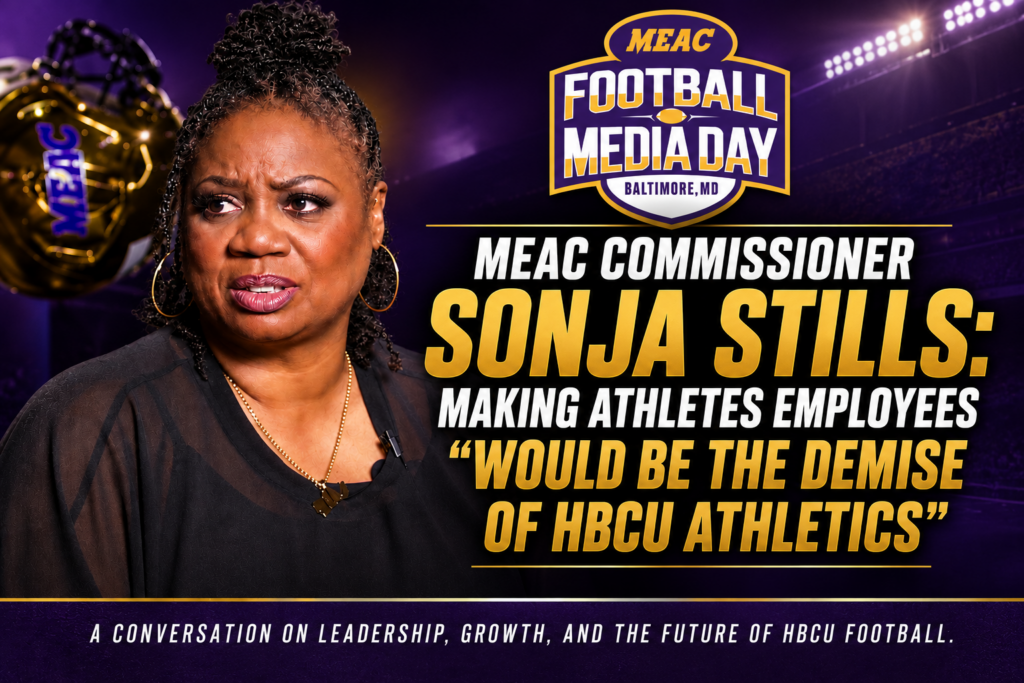
MEAC Commissioner Sonja Stills has drawn her sharpest line yet on the question hanging over every college sports bill in Congress: whether student-athletes should be classified as employees of their schools. Her answer, delivered in an interview with Tondea King of HBCU Nightly at MEAC media day on July 21, was that employment status would not just strain HBCU athletic departments. It would end them as they exist today.
“We cannot have student athletes as employees,” Stills said. “That would be the demise of HBCU athletes as we see them today.”
Stills said she and the other HBCU conference commissioners have been lobbying on the issue for the last couple of years, and that keeping employment classification out of any federal framework has been their most consistent ask.
The Math Behind the Position
Stills framed the objection in operational terms. HBCU athletic departments, she said, cannot take on athlete payrolls while the basics still need funding. “We cannot afford to pay student athletes when we need to focus on the infrastructure, the facilities, and that type of thing,” she said, asking why a school would pay athletes enough to drive luxury cars while the facilities they practice in go without.
Employment classification would go well beyond the revenue sharing schools can now opt into. Employees come with wages, benefits, workers’ compensation, and potential collective bargaining, obligations that scale poorly for departments that already operate on a fraction of what larger programs spend.
Paying for Settlements They Did Not Cause
Stills also pointed to a cost HBCU programs are already absorbing: the legal settlements arising from lawsuits she described as “really aimed at the power four institutions.” Because MEAC schools are NCAA members, she said, “we still have to pay into the settlements regardless,” and those payments reduce the revenue available to their student-athletes.
“We already know that historically HBCUs are underfunded,” Stills said. “So we need to be able to protect our HBCUs in that way.”
Where the Bill Stands
The legislative vehicle has changed since the spring. Stills noted that the SCORE Act, the House bill that HBCU conferences engaged with last year, is dead. The active bill is the Protect College Sports Act of 2026, which advanced out of the Senate Commerce Committee on a bipartisan 19-9 vote in July and now awaits consideration by the full Senate.
Stills was measured about the new bill. “The framework is there,” she said. “It still needs a lot of refinement before we can really truly support it.” The refinement she wants starts with the employment question. As written, the bill is neutral on whether athletes can be classified as employees, leaving the current legal fights to play out. That is the same gap the MEAC flagged in its June letter to Congress, which asked lawmakers to rule out employment classification explicitly, going a step further than the SWAC’s letter sent five days earlier.
Beyond employment, Stills listed two more priorities. She wants federal preemption of the patchwork of state name, image and likeness laws, which she said creates real problems for conferences whose members span multiple states. “We need one consistent bill,” she said. And she endorsed the bill’s transfer provisions, which allow one transfer without penalty. “It’s been the wild west,” she said, adding that a second transfer should mean sitting out a year.
“We Are Not the Development League”
Stills closed the exchange with the clearest statement of where the MEAC stands on the larger question of what college sports should be. Athletes chasing the biggest offer from school to school, she argued, is the behavior the rules need to calm down, and the focus belongs on the degree.
“We are here to graduate student athletes,” she said. “We are not the development league. We are not semi-pro. It’s amateurism, and that’s the way it needs to stay.”
Source: MEAC Commissioner Sonja Stills in an interview with Tondea King, HBCU Nightly, July 21, 2026.