Updated August 6th, 2025.
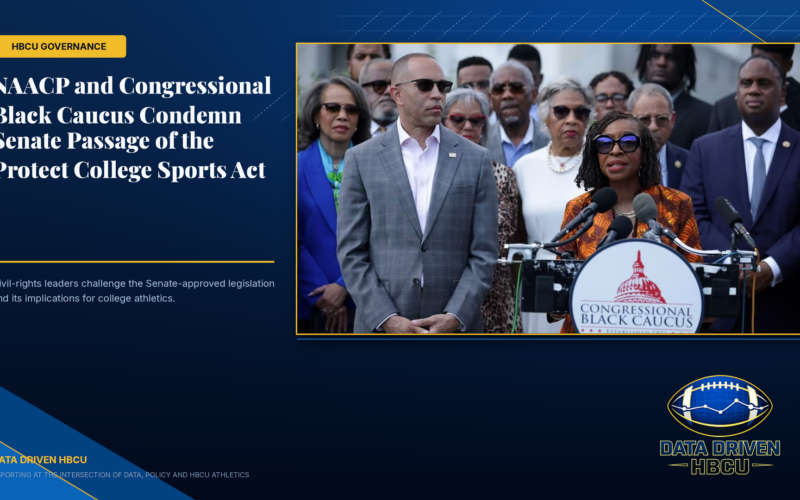
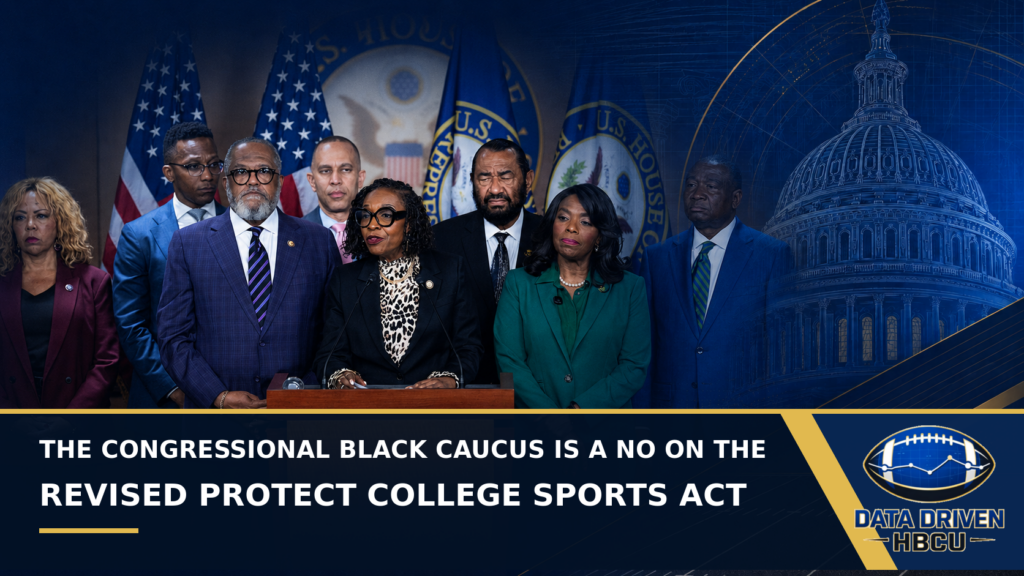
Two days after the Senate Commerce Committee released revised text of the Protect College Sports Act, the version that wrote an entire title of the bill for HBCUs, the Congressional Black Caucus announced it is not on board. In a statement issued Thursday by Chair Yvette D. Clarke of New York and members of the caucus, the CBC said it “cannot support advancing the Protect College Sports Act in its current form.”
The statement is a harder position than the one the caucus took in June, and it lands at the moment the bill’s supporters can least afford it. Senate Majority Leader John Thune has moved the bill toward the floor but has not committed to a vote before the Senate leaves for an extended recess at the end of this week.
The caucus did not have the day to itself. On the same date, UNCF (United Negro College Fund) sent the bill’s authors a letter expressing “enthusiastic support” for the legislation on behalf of its 37 member institutions. By the end of the day, the country’s largest private HBCU organization and the caucus that counts HBCUs in its portfolio were on the record on opposite sides of the same bill.
From a Pause to a No
When we covered the CBC’s June 3 letter, the caucus was asking for a pause. Its condition was specific: college athletics leadership, including the SEC, ACC and NCAA, needed to engage on what the caucus described as attacks on Black political representation before Congress extended new legal protections to those institutions. The caucus was not opposing the bill. It was setting terms.
Thursday’s statement acknowledges the bill has changed since then and says the caucus’s position has not. “The legislation before the Senate has evolved,” the statement reads. “However, the fundamental concerns of Black collegiate athletes, coaches, agents, HBCUs, and the communities we represent have not.”
The political representation argument is still the frame. The caucus writes that as states take steps to dismantle Black political representation and erode Voting Rights Act protections, Congress is simultaneously rewriting the economic rules of college athletics, and that those two things cannot be separated. “We will not be complicit in efforts to further exclude the interests of Black people by advancing legislation that will determine the economic future of Black athletes, their families, and their communities without their meaningful participation and engagement,” the statement reads.
But the substantive critique has expanded. The caucus now says the legislative process itself failed. Despite months of negotiations and multiple Senate hearings, the statement says, the process “has failed to meaningfully incorporate the perspectives of Black athletes, Black coaches, Black agents, HBCUs, or the Congressional Black Caucus.” Then it adds a line aimed at anyone counting roundtables as outreach: “Meaningful engagement is measured by results, not meetings.”
On the bill itself, the caucus argues the legislation “grants sweeping new legal protections to powerful institutions while failing to adequately protect the athletes whose talent fuels this multibillion-dollar industry.” It notes those concerns are shared by the NAACP and a coalition of athlete advocates, labor organizations and civil rights groups, the same coalition that sent a letter to Senate leadership on Tuesday urging a delay, which we covered in Tuesday’s analysis.
The Statement Does Not Mention Title III
What makes the timing notable for this site’s readers is what the statement does not address. The revised floor text contains Title III, the HBCU Sports Media and Connectivity Program, which authorizes up to $180 million a year for six years for broadband, media production, and sports broadcast infrastructure on HBCU campuses. The revision also added two HBCU seats and two mid-sized conference seats to the Congressional Commission on the Future of College Athletics. Those are the most direct HBCU provisions this legislation has carried in any version.
The CBC statement engages with none of it. There is no reference to the grant program, the commission seats, or any specific provision that has been added or removed since markup. That silence is consistent with the caucus’s stated objection, which is about process and power rather than line items. The argument is not that the bill contains nothing for HBCUs. It is that Black athletes, coaches, agents, and the institutions that serve them were not meaningfully at the table when the rules were written, and that money authorized for campuses does not answer the question of who governs the industry. “Nothing about us without us,” the statement closes.
The Same Day, UNCF Went the Other Way
The UNCF letter, dated Thursday and addressed to Cruz and Cantwell, is signed by President and CEO Michael L. Lomax and Lodriguez V. Murray, the organization’s senior vice president for government affairs. It thanks the two senators for “exceptional bipartisan leadership” and makes the institutional case for the bill: a uniform national framework replacing the state-by-state patchwork, “enabling HBCUs to recruit and retain exceptional talent on a more level playing field,” alongside scholarship protections, disclosure requirements in the name, image and likeness marketplace, and stronger oversight of athlete representation. “HBCUs must not be left behind as college athletics evolve,” the letter states.
The letter also names the lineage of the HBCU provisions we broke down on Tuesday. UNCF writes that it is “especially appreciative of the Committee’s incorporation of provisions reflecting the objectives of the IGNITE HBCU Excellence Act,” the standalone HBCU infrastructure legislation whose goals now live inside the bill’s Title III grant program.
And UNCF attached its own price to the partnership. A substantial portion of the letter concerns a separate issue: full forgiveness of the remaining debt that HBCUs carry under the federal HBCU Capital Financing Program. UNCF says it is “reassured by your commitment to work with us this year” on that question, and argues that forgiveness “unlocks resources that could be redirected toward expanding educational opportunity, strengthening America’s workforce, advancing research, and increasing institutional competitiveness for decades to come.” The support is enthusiastic, but it arrives with the expectation that the same bipartisan coalition will deliver on the debt.
The Caucus and the Institutions Are Not in the Same Place
The two Thursday documents confirm a split that has run through this debate since spring, and deepen it. The SWAC endorsed the bill in June. The MEAC backed it too, with reservations about employee classification. Texas Southern’s president made the affirmative case at a Senate roundtable. Now UNCF has added its 37 member institutions to a supporter list that already included HBCU conferences, along with 28 other conferences and more than 370 schools.
The CBC, which describes itself as speaking for HBCUs and the communities around them, has reached the opposite conclusion about the same bill. Both positions are on the record, and neither has moved the other. The conferences and UNCF are betting that cost controls, legal stability, Title III money and, in UNCF’s case, momentum on debt forgiveness are worth more than the concessions the bill extracts. The caucus argues that no version of that trade should clear Congress without the affected communities helping set its terms.
The Math and the Clock
The practical question is whether the statement changes votes. The CBC’s direct Senate footprint is small, but its statement is not aimed at its own members. It is aimed at Senate Democrats, who the caucus says “now have both the opportunity and the responsibility to insist that this legislation reflects the interests of Black athletes, HBCUs, and the communities it will most directly affect.” The bill needs Democratic votes to clear the 60-vote threshold, and the committee vote in June already showed where the friction is: seven of the committee’s Democrats voted against advancing it even as Ranking Member Maria Cantwell co-authored it.
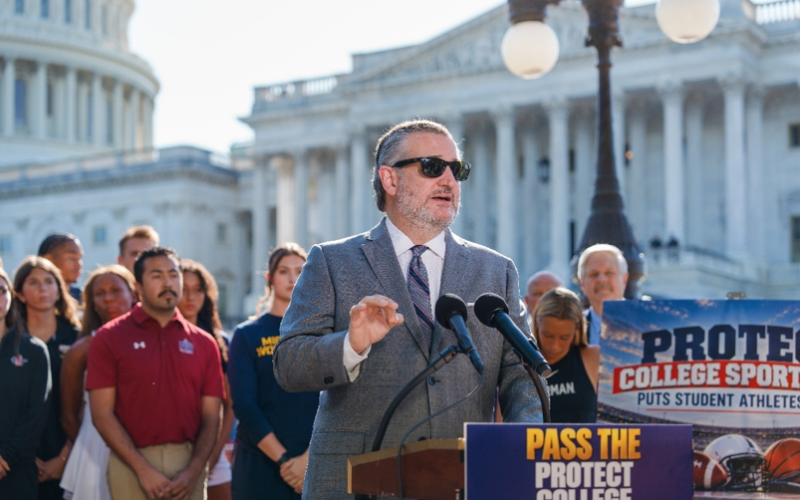
The clock is the other variable. Thune declined to guarantee floor time this week, telling reporters, as reported by Roll Call, “Can we produce a big vote for it on the floor? Can we get it in the queue somehow? I mean, these are all, these are some unanswered questions.” Ted Cruz, the bill’s lead sponsor, is publicly predicting a big bipartisan Senate vote this week, telling CBS Sports he hopes President Trump will sign the bill on College GameDay this fall after House passage. If the Senate leaves for recess without a vote, the bill will wait until fall, and the CBC’s statement will become the marker Democrats will be asked about in the interim.
In May, the HBCU stake in this bill had to be inferred from revenue thresholds. By August, the bill names HBCUs directly; HBCU conferences and the largest private HBCU membership organization are on the supporter list; and the caucus that bears their name in its portfolio says the bill is still not theirs. Whatever happens on the floor, that disagreement, sharpened into a single Thursday, is now part of the record this legislation carries.