The Senate Commerce Committee released the revised text of the Protect College Sports Act on Tuesday, days after the SEC and Big Ten endorsed the bill Friday night. Committee Chairman Ted Cruz of Texas, Ranking Member Maria Cantwell of Washington, and Senator Eric Schmitt of Missouri agreed on the modified language roughly five weeks after the committee advanced the bill on a 19-9 bipartisan vote. Most of the announced changes deal with the revenue share cap, name, image, and likeness enforcement, and recruiting rules. But buried at the back of the 171-page floor text is the most significant development for HBCUs since this legislation was introduced: an entire new title of the bill written specifically for them.
When we analyzed the original bill in May, the HBCU-specific provisions had to be inferred from revenue thresholds and conference definitions. Not anymore. The revised bill contains Title III, the HBCU Sports Media and Connectivity Program, which was not in the version introduced in May and appears in the committee’s own summary of changes made since markup.
What Title III Would Do
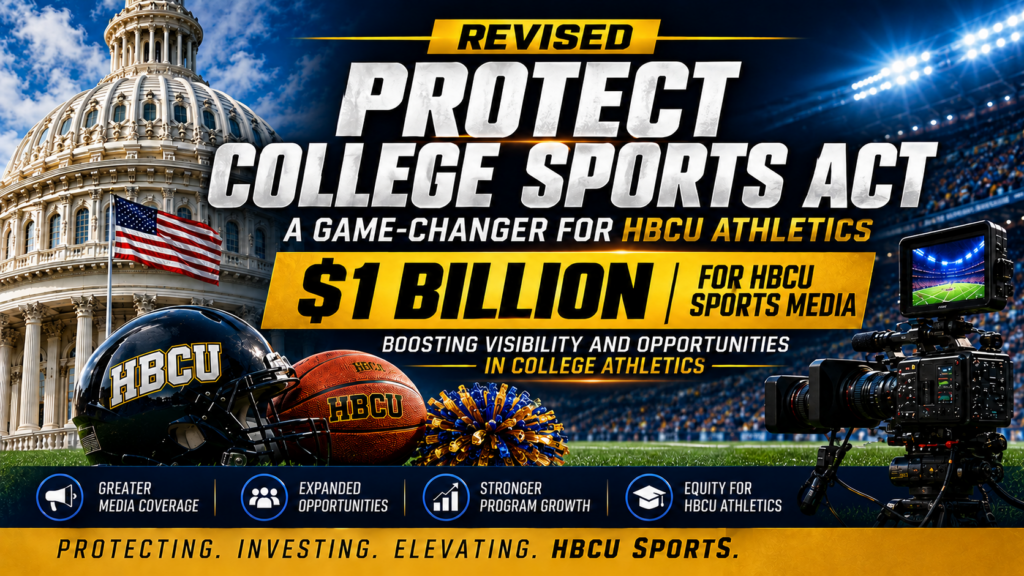
Title III creates a competitive grant program, run by the Assistant Secretary of Commerce for Telecommunications and Information in consultation with the Secretary of Education, to fund long-term improvements to campus broadband, information technology, media production, and sports broadcast infrastructure at HBCUs. The authorization is $180 million per year for each of fiscal years 2027 through 2032. Across six years, that is up to $1.08 billion authorized for HBCU campuses.
The sports broadcast language is remarkably specific. Grant funds can be used to build production control rooms, master control facilities, and mobile production units. They can buy cameras, replay systems, graphics, audio equipment, and fiber, satellite, and internet transmission infrastructure. The bill sets the bar where it matters: equipment “sufficient to produce live coverage of intercollegiate athletic events at the technical standards of national and regional video programming distributors.” Funds can also build streaming infrastructure that lets a school distribute live games directly to the public, including within its own local market, and fund programs that train students in sports production, distribution, and media operations.
Beyond athletics, grants can fund campus-wide broadband networks, journalism and broadcast engineering facilities, cybersecurity upgrades, and broadband subscriptions for enrolled students who demonstrate financial need through their federal aid applications and lack access at home.
The mechanics are built for sustained investment rather than one-time awards. Grants run between two and five years, a school may apply for and hold more than one grant, and eligibility extends to every HBCU as defined in federal higher education law, not just Division I members. The Commerce Department is also required to provide technical assistance to help schools qualify for and apply for the funding.
The Priority Criteria Read Like an HBCU Financial Profile
Grant programs live and die by their selection criteria, and the criteria in Title III track the financial realities this site documents. Priority goes to schools that demonstrate the greatest infrastructure needs and the most limited capacity to raise money on their own, as measured by endowment size, bond rating, deferred maintenance, historical fundraising ability, and enrollment. Additional priority goes to schools enrolling the highest percentages of Pell-eligible students, and to public institutions facing declining state support with limited ability to generate revenue.
Then the bill goes further. The Assistant Secretary may also prioritize applicants who are members of an HBCU athletic conference, who commit to using the funded facilities to produce live coverage of women’s sports and Olympic sports, or who have a distribution partnership in place with a conference, an athletic association, or a video programming distributor. Every school in the Division I HBCU cohort checks the conference box, and so do the Division II members of the CIAA and SIAC, because eligibility is not limited to Division I.
Why This Is the Answer to the Broadcast Question
Our May analysis argued that the bill’s local broadcast access provision could be the most consequential part of the legislation for HBCU fans: the grandmother in Itta Bena who cannot watch Valley State play behind a streaming paywall, the recruit’s family in Baton Rouge that should not need a subscription to watch Southern. That provision, Section 204, remains in the bill, and it still depends on conferences voluntarily joining the pooled media entity that the legislation would create.
Title III attacks the same problem from the other side. A local broadcast requirement only matters if schools can produce a broadcast worth carrying, and production capacity is exactly what most HBCU athletic departments cannot fund out of budgets that already depend heavily on university support. Across the 16 public schools in our most recent financial reporting cohort, 73.9 percent of total athletic revenue came from university-wide support and student fees. Title III puts federal money into control rooms, cameras, and student production crews so that the games are broadcast-quality in the first place, and its priority structure rewards schools that commit to putting those games in front of their local markets.
HBCUs Get Seats on the Commission
The revision also changes the Congressional Commission on the Future of College Athletics, the body we flagged in May as the venue where the structural arguments about smaller programs will eventually be decided. The Commission has grown from 20 to 24 members, and the four new seats are spoken for: two representatives of HBCUs, appointed by the Senate majority leader and the Speaker of the House, and two representatives of mid-sized conferences, defined as conferences generating less than $500 million in annual revenue. Every HBCU conference fits under that ceiling.
In May, we wrote that the Commission’s five-year review window would only be useful if someone showed up prepared to argue for specific changes with specific evidence. The revised bill guarantees that HBCUs and their conferences will be in the room. A companion provision, Section 126, separately requires that mid-sized conferences receive adequate representation on the governing boards and rulemaking committees of any athletic association they belong to.
What Did Not Change
The structural concerns from our May analysis remain in the floor text, essentially untouched.
The bill is still neutral on employee status. Section 122 still states that the title does not alter employee or non-employee status for student-athletes. That means the revision did not adopt the MEAC’s specific request, made in its June letter to Congress, that the bill explicitly state athletes are not employees. MEAC Commissioner Sonja Stills has called employee classification “the demise” of HBCU athletics as they exist today. The ongoing federal cases on that question remain live under this bill, for better or worse depending on which side of that argument you sit.
The pooled media entity’s distribution formula is also unchanged where it matters most. The equal-distribution tier still splits 15 percent of remaining collective media revenue among institutions that had football revenue in the Football Bowl Subdivision. Every football-playing school in the Division I HBCU cohort competes in the Football Championship Subdivision, so that tier remains closed to all of them. The pool is still funded by earned revenue, and university support and student fees do not count. The post-eligibility medical fund still uses a $20 million revenue threshold, leaving Howard, Norfolk State, Morgan State, and NC A&T above the line on paper.
Two of the headline changes cut in directions worth noting for this cohort even if they were not written with it in mind. The new retention fund allows a school to spend up to $22.5 million above the revenue-share cap each year to keep its own players, rising to $27.5 million if the school matches the increase dollar-for-dollar with compensation for athletes in women’s, Olympic, and other non-revenue sports. That flexibility is real money for power-conference programs. For a cohort where entire athletic department budgets are smaller than the retention allowance, it is a reminder of the scale gap this bill regulates. And the conference consolidation guardrails were tightened to focus on conferences reporting more than $700 million in annual revenue, down from the higher threshold in the earlier text, with a 19-institution cap on expansion and a new prohibition on private equity assembling a breakaway super league from those conferences’ schools.
What Happens Next
The bill’s coalition now spans 28 conferences, more than 370 colleges and universities, HBCUs, the players associations for the NFL and NBA, the four major professional leagues, and the U.S. Olympic and Paralympic Committee. With the SEC and Big Ten publicly on board, the largest remaining question is floor timing, and Cruz made his intent plain: “College sports cannot afford another punt. I urge my Senate colleagues to finish the drive and get this bill across the goal line.”
The opposition answered the same day. In a letter sent Tuesday to Majority Leader John Thune and Minority Leader Chuck Schumer, ten organizations urged the Senate to delay any floor vote “until the legislation more adequately addresses the needs and concerns of college athletes.” The signers include the NAACP, the AFL-CIO, the National College Players Association, and Athletes.org, the athlete advocacy group whose opposition we covered in June, along with antitrust and legal advocacy groups and the Sports Fans Coalition. The letter describes the coalition as representing college and professional athletes, labor unions, and women’s and civil rights organizations, and its makeup underscores the divide that has defined this bill from the start: the institutions of college sports are lined up behind it, and the organizations claiming to speak for athletes are not.
For HBCUs, one more caveat belongs at the end. Title III is an authorization, not an appropriation. Congress authorizing $180 million a year does not put $180 million a year into the program; appropriators have to fund it, year by year, after the bill becomes law. The program also cannot accept applications until the Commerce Department publishes its criteria, weights, and timeline following a public comment period. The distance between a bill text and a control room on an HBCU campus is still long. But for the first time in this legislative saga, the text names HBCUs not as an edge case caught by a revenue threshold, but as the point.