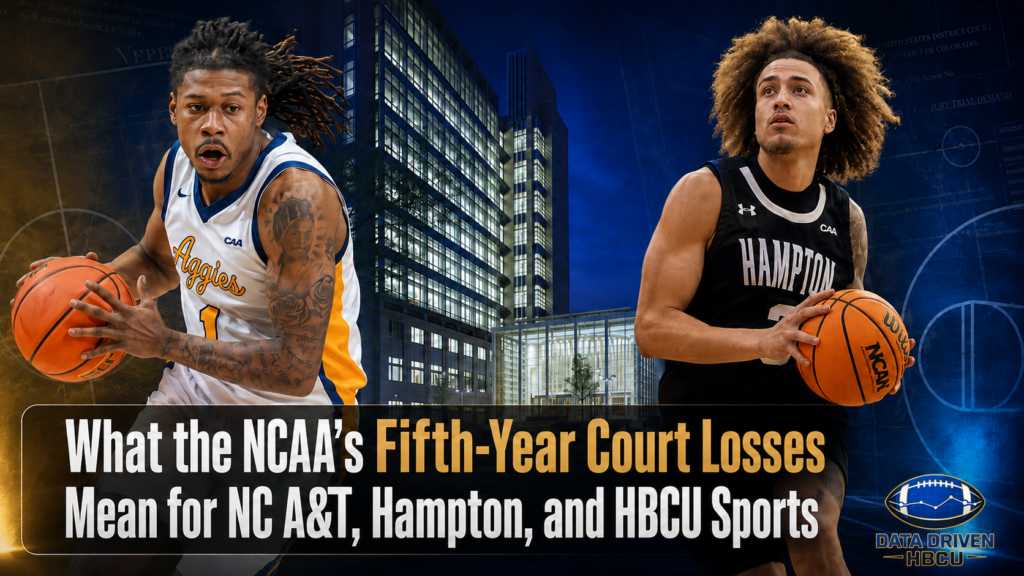
By the NCAA’s old math, Bryson Ogletree was done. The North Carolina A&T guard started his college career at South Plains College, a junior college in Texas, before transferring to Greensboro in 2024, and the NCAA counted those junior college years against his four-season limit even though junior colleges are not NCAA members. When the Aggies’ season ended this spring, so, on paper, did his eligibility. Up the road in Hampton, Michael Eley was in the same position. The Pirates’ leading scorer, coming off a career-high 43 points against Campbell in January, was out of years too.
Both players are now plaintiffs in Okpara v. NCAA, a lawsuit filed in late July in Guilford County Superior Court, in the Aggies’ home county, where more than 50 athletes, headlined by former NC State players Darrion Williams, Tre Holloman, and Ven-Allen Lubin, are asking a judge to let them play a fifth season in 2026-27. Court records list Ogletree and Eley among them, alongside Po’Boigh King, an All-MEAC guard at North Carolina Central before finishing this past season at Sam Houston. For two CAA HBCU programs, the outcome of this litigation is not an abstraction. It is the difference between returning a proven starter and replacing one.
And the momentum is entirely in the players’ direction. On August 5, the Superior Court of Cobb County, Georgia, granted an interlocutory injunction in Godfrey v. NCAA, becoming the seventh court in under a month to block the NCAA from enforcing its old eligibility limits against athletes who had just aged out of them. Courts in Ohio, Tennessee, Colorado, New Jersey, Texas, and Oklahoma have issued similar orders since July 9, and the Colorado ruling, a federal decision, covers a nationwide class of Division I athletes across all sports. That means players in Ogletree’s and Eley’s cohort are positioned to benefit whether or not their own Greensboro case reaches a ruling before the season.
The rule change that left the Class of 2022 behind
In June, the NCAA finalized a new age-based eligibility model for Division I. Instead of the long-standing framework of four seasons of competition inside a five-year window, athletes now get up to five seasons, with the eligibility clock starting the academic year after they turn 19 or when they first enroll full time, whichever comes first. The model eliminates redshirts, season-of-competition counting, and most eligibility waivers.
The new rules apply to athletes currently in the system and to incoming classes. The group left out is the high school Class of 2022: players like Ogletree and Eley who used their fourth season this past year and, under the old rules, were finished. Their lawsuits argue that the NCAA cannot hand a fifth season to everyone behind them while denying it to players who are still within five years of enrolling and of their 19th birthday. So far, every court to rule on the question has agreed, at least preliminarily.
| Court | Case | Date | Scope |
|---|---|---|---|
| Hamilton County, Ohio | Borovicanin v. NCAA | July 9 | Preliminary injunction |
| McLennan County, Texas | Wheeler v. NCAA | July 29 | Temporary restraining order |
| Payne County, Oklahoma | Oates v. NCAA | July 29 | Temporary restraining order |
| Essex County, New Jersey | Kromah v. NCAA | July 30 | Preliminary injunction |
| Davidson County, Tennessee | Washington v. NCAA | July 31 | Temporary injunction, 19 basketball players |
| U.S. District Court, Colorado | Wisne v. NCAA | July 31 | Preliminary injunction, nationwide Class of 2022 |
| Cobb County, Georgia | Godfrey v. NCAA | Aug. 5 | Interlocutory injunction |
| Guilford County, North Carolina | Okpara v. NCAA | Aug. 5 hearing | Injunction pending, 50-plus players including Ogletree and Eley |
Sources: Order Granting Interlocutory Injunction, Godfrey v. NCAA, Superior Court of Cobb County, Georgia, Civil Action No. 26CV05617 (Aug. 5, 2026); Guilford County Superior Court records, Okpara v. NCAA.
What the Georgia order does
The Cobb County order blocks the NCAA from enforcing Bylaw 12.6, its seasons-of-competition rule, against a group of basketball plaintiffs led by RJ Godfrey, who played at Clemson and Georgia, for the 2026-27 season. Notably, for players like Ogletree, the court called out the junior college counting practice by name, listing the NCAA’s treatment of junior college years as equivalent to NCAA seasons among the arbitrary practices that supported the players’ breach-of-contract claim. It also barred the NCAA from disqualifying plaintiffs for skipping the transfer portal or signing professional contracts while ineligible, so long as they exit those deals and return any pay beyond basic expenses.
The order also protects the schools. The court enjoined the NCAA’s Rule of Restitution and its so-called ghost transfer rule, tools the NCAA could otherwise use to punish a school or coach for rostering a player under a court order that is later reversed. Any program that rosters a protected player, and any program that competes against one, is shielded. That protection removes the hesitation to comply that has historically kept lower-resourced athletic departments, including HBCUs, on the sidelines of these disputes.
What a fifth year means in Greensboro and Hampton
For A&T, the stakes are concrete but complicated. Ogletree started for the Aggies in 2024-25, averaging 10 points and 5 rebounds per game, and returned for a second season in 2025-26 under third-year coach Monté Ross. A rebuilding program now has a path to bring back an experienced starter it expected to lose, and to do so with court protection rather than a waiver request sitting on an NCAA desk. The complication is that Ogletree has indicated he intends to enter the transfer portal, and the timing gives him a live path out. Following the Wisne ruling, a special portal window opened August 3 through August 10 for reinstated players. The federal judge clarified that her injunction restores a fifth season and nothing else, meaning athletes who use it remain subject to the NCAA’s transfer rules, and the special window is exactly that process at work. For A&T, the ruling that gives Ross a chance to keep his starter also means the program has one week to re-recruit him against every school with a roster hole and a bigger budget.
Hampton’s version of the story is arguably bigger. The Pirates were picked in the top half of the CAA before this past season, and Eley was their engine, leading the team in scoring at 13 points per game. A fifth year from a proven number-one option changes the calculus of a conference race. For both programs, the practical question is no longer whether these players are eligible. Courts in seven jurisdictions say they are, for now. The question is roster planning: holding a spot open, structuring scholarship and revenue-share agreements, and moving inside a portal window that closes August 10, before other programs recruit the same reinstated players out from under them. The Godfrey order noted that coaches around the country have been holding roster spots open in anticipation of exactly this outcome.
The junior college issue deserves particular attention across HBCU basketball. Rosters throughout the SWAC, MEAC, and CAA carry players who came up through the junior college route, and the old counting rules could end those careers after only two or three seasons on a Division I floor. The players these rulings restore are disproportionately the kind of veterans HBCU programs depend on.
The roster math for HBCU football
The Colorado class covers Class of 2022 football players nationwide, and the timing is the story. Fall camp is underway. Rosters that coaches considered settled in May now face a late wave of returning fifth-year players across every level of Division I, and the ripple effects run in both directions for HBCU programs.
The pressure runs downhill first. When power-conference and other FBS programs welcome back veteran players they expected to lose, the roster spots those veterans reclaim come at someone’s expense. Under the House settlement’s roster limits, a football roster caps at 105. A returning fifth-year starter can displace a younger player, and displaced FBS players tend to look down a level for playing time. SWAC, MEAC, and CAA programs could see an influx of experienced late-summer transfers, some of them the same caliber of player these programs usually lose to the portal rather than gain from it.
The counter-effect works in HBCU programs’ favor on retention. HBCU football has been a net exporter of talent in the portal era. SWAC coaches have watched top players move up to FBS rosters in growing numbers, and more than 30 SWAC players entered the portal in this past cycle, with MEAC programs close behind. If FBS rosters are suddenly crowded with returning veterans, there are fewer open spots for those transfers to move up into, which could keep more proven HBCU starters home this fall and next.
The limits of the rulings
The scope of the nationwide order has been narrowed in an important way. The federal judge overseeing the Colorado class clarified that her injunction grants a fifth season of eligibility and nothing more. It does not suspend transfer rules, roster caps, or revenue-sharing caps, and it excludes athletes who are over 24 or who have signed a professional contract. For roster planning, that means a returning fifth-year player generally still counts against the limits, 105 in football and 15 in basketball. The Godfrey court did point to one workaround for its own plaintiffs, noting they could be treated as Designated Student Athletes under the House settlement’s methodology and kept off the roster count, but that suggestion applies to the Georgia case, not the nationwide class. The Georgia order also goes further than the nationwide class on professional contracts: its plaintiffs can return even after signing a professional contract, provided they exit the deal and return any pay beyond expenses, whereas the nationwide class excludes players who signed professional contracts.
What happens next
None of this is final. The NCAA has appealed the Colorado ruling, arguing that the injunctions threaten to unsettle rosters across the 2026-27 season, and it is seeking stays. The Cobb County court set trial for January 2027, and the Tennessee and Ohio cases are on similar tracks. A reversal on appeal midseason would create its own chaos, which is part of why the Georgia court barred the NCAA from punishing any school that complies in the meantime.
For A&T, Hampton, and HBCU programs generally, the practical guidance is simpler than the legal picture. Fifth-year players from the Class of 2022 are, for now, eligible, and schools that roster them are protected by court order. The programs that move quickest in the late-summer market, on both the basketball and football sides, are the ones positioned to benefit from a rule change written without this class in mind.
The hearing for Okpara v. NCAA is on August 5th, and we’ll keep readers posted on whether the judge in the case issues an injunction.