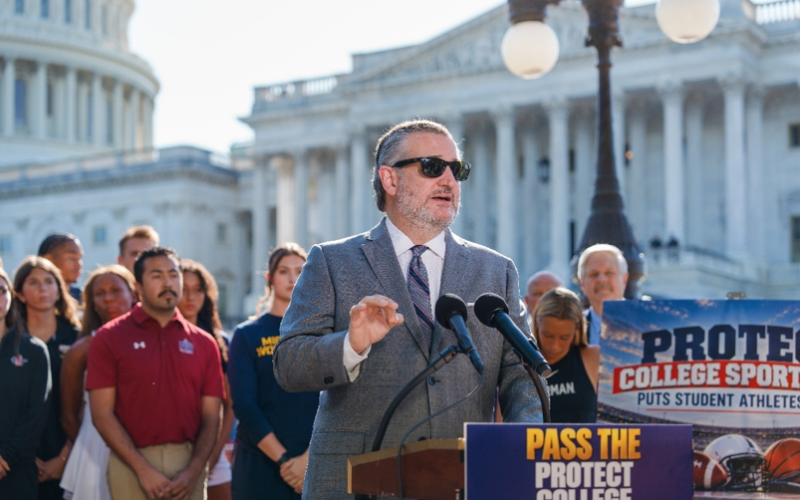
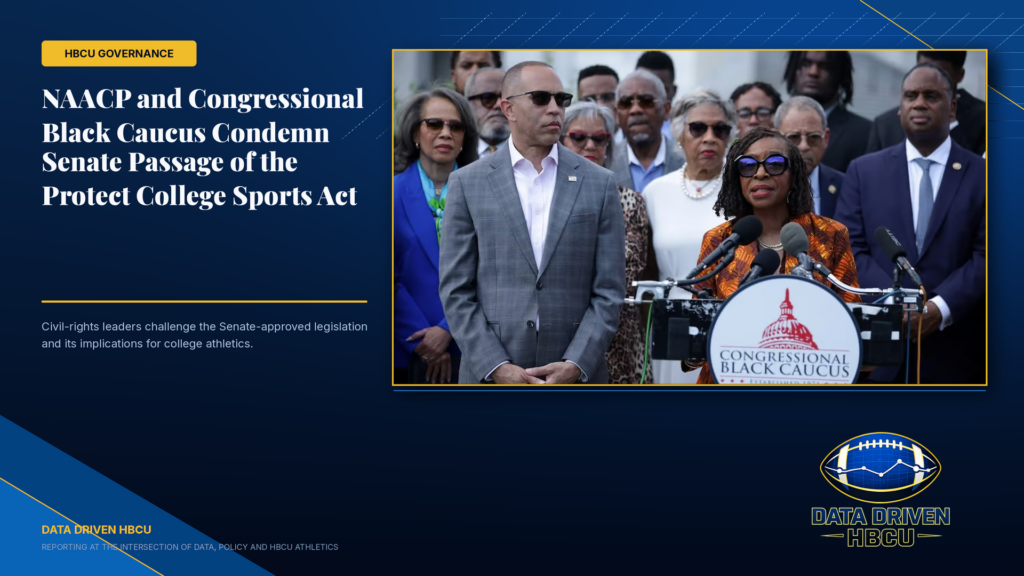
The day after the Senate passed the Protect College Sports Act, the NAACP and the Congressional Black Caucus each issued formal statements condemning it. Both organizations opposed the bill throughout the process this site has tracked since May. Tuesday’s statements were their first on record addressing the bill after it actually cleared the Senate floor, 77-22.
NAACP: “Sharecropping Is Over”
NAACP President and CEO Derrick Johnson released a statement Tuesday framing passage as a loss for the athletes the bill claims to protect. “The so-called Protect College Sports Act only serves to give even more power to colleges and universities at the expense of student-athletes,” he said. “It protects those powerful schools from accountability while stripping student-athletes’ ability to collectively bargain and limits their compensation for their hard work and skill.”
Johnson closed with the sharpest line of the statement: “We cannot continue to ask Black student-athletes to generate billions in revenue on the field and the court while they shoulder all the risk and receive none of the guaranteed security they deserve, like secure long-term healthcare and educational protections. Sharecropping is over, and this bill will only serve to harm student-athletes.”
The statement repeats an argument Johnson first raised the day the bill cleared its first Senate test, that its HBCU funding is authorized, not appropriated. Tuesday’s statement condensed that distinction into a sharper line, calling the funding “vague promises of funding for HBCUs as a political trade-off for the harm this legislation will do to Black student-athletes.”
Johnson wasn’t the only voice in the statement. Kevin Weaver, identified as the parent of a Division I student-athlete in Cleveland, Ohio, was quoted directly: “I think the biggest failure in this bill is that student-athletes don’t have a voice or any input into legislation that will impact them the most.”
The statement also ties back to the NAACP’s Out of Bounds campaign, which Tuesday’s coverage of the NAACP’s full written case examines in depth. The new statement adds a specific legal citation it hadn’t used before: the Supreme Court’s decision in Louisiana v. Callais, which the NAACP says opened the door to new voting maps in states that also profit from major college athletic programs.
Going forward, the NAACP says it is calling for a college sports framework built around five specific protections:
- Collective bargaining rights
- Continued access to education following sports-related injuries
- Lifetime healthcare coverage for life-altering injuries
- Ownership and protection of athletes’ name, image, and likeness rights
- Commitments on hiring, supporting, and recruiting of Black coaches
The NAACP made the first of those points more pointedly on social media Tuesday.
You know what would “enhance” players opportunities to be more successful?
The ability to be at the table and negotiate when decisions are being made about their lives and their future.
Quit looking into cameras and “HUDDLE UP!” https://t.co/KFeO6dviwp
— NAACP (@NAACP) September 29, 2026
Congressional Black Caucus: No Engagement From the Senate
CBC Chair Yvette Clarke of New York issued a separate statement Tuesday on behalf of the caucus. It leads with a claim about the legislative process itself: “Months ago, we urged the Senate to pause consideration of this legislation until our substantive issues were addressed and until college athletics leaders engaged with us about the attacks on Black political representation. To date, there has been no meaningful engagement with the CBC from the Senate on this legislation, nor have college athletics leaders meaningfully engaged with us on the critical issues of civic engagement and Black political representation.”
The statement lists three specific shortcomings in the bill as passed. It “fails to provide student-athletes with employment rights, includes antitrust provisions that restrict student-athletes’ ability to bring private legal action when disputes arise, and fails to guarantee funding for HBCUs,” Clarke said.
That complaint lines up with the position this site has tracked from the CBC, the NAACP, Booker, and Murphy throughout this process: all of them have argued athletes need more leverage over their own working conditions, not a bill that stays neutral on employee status, let alone the outright ban House Majority Leader Steve Scalise is reportedly pushing for once the bill reaches the House.
Clarke’s statement closes with where the CBC goes from here: “The CBC will continue to oppose this legislation in its current form and will continue to advocate for a college athletics system that protects athletes, respects their rights, invests in HBCUs, and ensures that the communities that built this industry have a meaningful voice in its future.”
Neither statement changes the vote count or the bill’s text. What they add is a clearer picture of what happens next from the two organizations that opposed this bill from the start. The NAACP now has a five-point platform it says it will keep pushing for, and the CBC has confirmed, in its own words, that months of requesting engagement from the Senate produced none. Both statements point toward the same open question heading into the House: whether a chamber that hasn’t engaged with the CBC on this bill so far engages with HBCU conferences, athlete advocacy groups, or the NAACP any differently once Section 122 becomes the specific fight.
This is the latest in this site’s coverage of the Protect College Sports Act’s implications for HBCU athletics. Early HBCU positions in June, MEAC Commissioner Sonja Stills on employee status, the August revision that added Title III, the Congressional Black Caucus’s no and UNCF’s yes, the cloture vote, and Monday’s final passage all trace the same divide that resurfaced this week.