The Senate passed the Protect College Sports Act Monday, 77-22, sending the bill to the House for the first time in either chamber’s history of trying to regulate college athletics by statute. The legislation codifies athlete compensation and NIL rights, standardizes a five-year eligibility period, sets a one-time free transfer with a required sit-out year for any transfer after that, guarantees multi-year scholarships that cannot be revoked for performance or injury, mandates extended post-career medical coverage, and grants the NCAA a limited antitrust exemption tied to enforcing its eligibility and transfer rules.
The bill’s most tracked HBCU marker held. Roll Call Vote 250 shows the same four senators who voted no on the cloture motion two weeks ago, Cory Booker, Raphael Warnock, Lisa Blunt Rochester, and Angela Alsobrooks, voted no again on final passage. Every Black member of the Senate Democratic caucus has now opposed this bill at every recorded vote.
A Bill That Kept Clearing the Bar, Vote After Vote
The path from cloture to passage ran through six separate roll calls over two weeks, and the bill never dropped below 70 yes votes at any stage.
| Date | Action | Yea | Nay |
|---|---|---|---|
| Sept. 15 | Cloture on motion to proceed | 74 | 24 |
| Sept. 17 | Motion to proceed adopted | 77 | 22 |
| Sept. 22 | Cloture on Cruz-Cantwell substitute | 70 | 21 |
| Sept. 24 | Cruz-Cantwell substitute adopted | 77 | 23 |
| Sept. 24 | Cloture on final passage | 74 | 25 |
| Sept. 28 | Passage, as amended | 77 | 22 |
The final text is the Cruz-Cantwell substitute adopted Sept. 24, not the version this site reviewed in August. Most of what this site has tracked survived that swap, including Title III, the HBCU grant program, and Section 122, which keeps the bill neutral on whether athletes are employees. One number did not survive intact. Title III now authorizes its HBCU funding over five years rather than six, up to $900 million total rather than the $1.08 billion this site cited when the title was first added in August.
Cruz Called Passage “A Monumental Day for College Athletics”
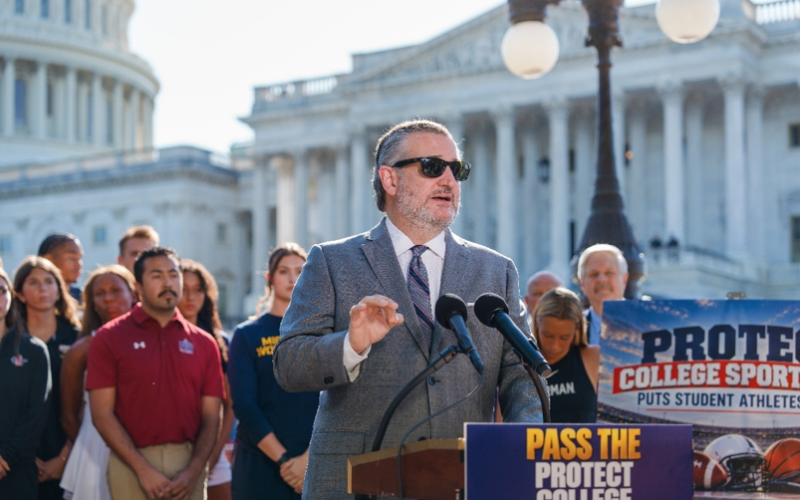
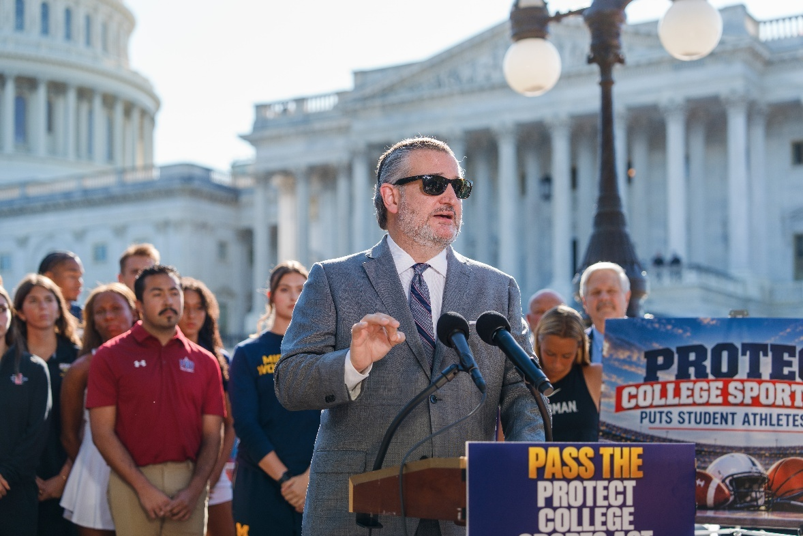
Senate Commerce Committee Chairman Ted Cruz, the bill’s lead author, described passage in very different terms than its opponents did. In a statement released the day of the vote, he called it “a monumental day for college athletics,” saying the Senate had voted “to protect the hundreds of thousands of student athletes currently competing in college sports, the millions who will follow in their footsteps, and every college sports fan who wants to preserve this great American tradition for generations to come.”
In his floor remarks ahead of the vote, Cruz described the coalition behind the bill in terms that named HBCUs directly. He told the Senate the legislation had “the support of 32 conferences… as well as more than 380 schools and historically black colleges across all 50 states and Washington, D.C., the NFL, the NBA, Major League Baseball, National Hockey League, the U.S. Olympic and Paralympic Committee, and more than five hundred thousand student athletes across the country.”
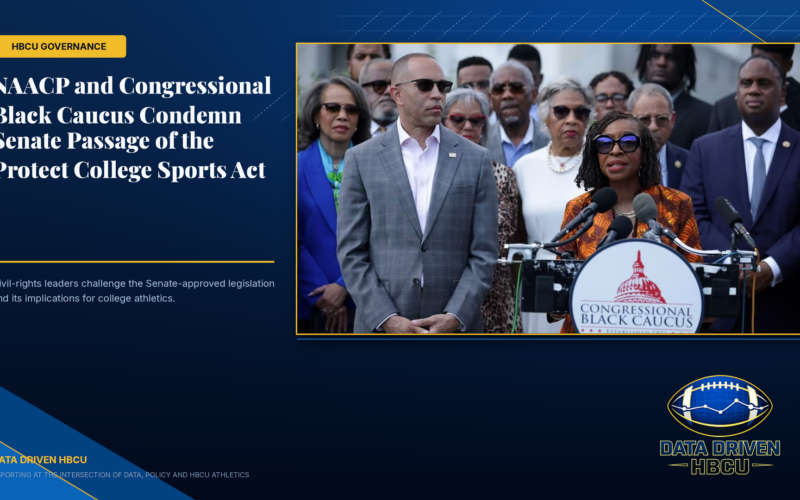
Cruz’s coalition count is institutional: conferences and schools, including individual HBCUs, that signed on in support. The NAACP, the Congressional Black Caucus, and all four Black members of the Senate Democratic caucus opposed the bill on separate grounds, objecting to specific provisions rather than to the broader project of standardizing NIL and transfer rules nationally. Both accurately describe where HBCU athletics stood on the day the Senate passed this bill.
Booker Explained the No Vote This Time
Where the cloture vote came without floor remarks from any of the four senators, Booker took to the Senate floor directly ahead of final passage. His office said he stood there with college athletes and organizations including the NAACP, the Congressional Black Caucus, and the AFL-CIO, all raising the same objection: that the bill was written without athlete input, shields the NCAA from accountability, and puts the burden of enforcement on the athletes themselves.
“At its core, it’s a bill that undermines the rights of young people who pour their blood, sweat, tears, countless hours of work, and more into their craft,” Booker said. “Listen to the athletes. Listen to those who represent them. This so-called ‘Protect College Sports Act’ isn’t about protecting college athletes; it’s about protecting wealthy coaches, powerful institutions, and an NCAA that’s held unbridled power for decades while athletes faced discrimination and injustice.”
Booker’s office backed the argument with figures on college sports spending: a roughly $20 billion industry with more than 40 football coaches earning over $5 million a year, and 15 fired coaches who collected nearly $250 million in contract buyouts in 2025 alone. “College athletes put their bodies on the line, and generate billions, they deserve a real voice and real rights,” Booker said. “This bill pulls the rug out from under them. Athletes deserve leaders who stand with them, and I’ll keep fighting alongside them.”
Watch Booker’s full floor speech below.
The NAACP’s Written Case, in Full
Previously, we covered Derrick Johnson’s television appearances against the bill. The NAACP’s fullest case against it is not a soundbite. It is an August 4 letter Johnson sent to Majority Leader John Thune and Democratic Leader Chuck Schumer, urging the Senate not to advance the legislation.
The letter’s central argument is economic and structural rather than provision-by-provision. Over the past decade, the letter states, schools in the Atlantic Coast Conference, Southeastern Conference, and Big 12 generated approximately $16 billion in athletic revenue, not counting NIL activity, with Black men making up an average of roughly 66 percent of football rosters at those schools. “The representation of Black athletes on the field bears little resemblance to the representation of Black students across many of these campuses,” the letter states, adding that Black male college enrollment has fallen to levels not seen in decades even as recruiting of Black men for their athletic ability continues.
The letter ties that gap to a broader argument the NAACP has made throughout this legislative fight: that public universities and athletic conferences should not receive new federal legal protections while staying silent on state-level efforts the organization says dilute Black voting power. “Any state that works to erase a Black congressional district cannot expect to celebrate a Black athlete’s touchdown on Saturday without being held accountable for suppressing that athlete’s community during the rest of the week,” the letter states. It calls the arrangement “a modern version of Jim Crow” and argues that states pushing those maps often draw more in federal outlays than they contribute in federal revenue, meaning Black taxpayers are, in the letter’s words, subsidizing the same systems working against their political power.
On the bill’s substance, the letter distinguishes between the protections it supports and the protections it opposes. “We recognize that the bill contains provisions concerning scholarships, health care, athlete agents, safety standards, and student-athlete representation. College athletes deserve those protections,” it states. “They should not, however, be used as political cover for provisions that insulate institutions and conferences from legal and economic accountability.” The letter names the antitrust protection, federal preemption of state NIL laws, expanded media bargaining authority, and limits on legal liability as the specific insulations it wants stripped out.
The letter closes with the campaign framing the NAACP has built around this fight, “Out of Bounds,” and its own three-part line: “No Representation. No Recruitment. No Revenue.”
Player Advocacy Groups Held Their Position Too
Athletes.org and the College Football Players Association, the two national athlete advocacy groups that have opposed this bill since the spring, both stayed opposed through final passage. Athletes.org executive director Brandon Copeland has argued the bill removes athlete leverage in future negotiations without addressing the spending it blames on athlete compensation.
CFBPA executive director Jason Stahl has made a related but distinct point: the bill was written without meaningful athlete input, and an antitrust exemption reduces pressure on the NCAA and conferences to negotiate with athletes directly rather than have Congress set the terms for them. Both organizations continue to point to collective bargaining, not federal statute, as the framework they want instead.
The House Fight to Watch: A Ban, Not Neutral Language
The bill’s next stop is a chamber that will not be in session again until Nov. 9, after the midterm elections. Passage before year-end is not guaranteed. The House must also work around a Dec. 11 government funding deadline that will consume floor time, and any version of this bill must clear the House and be reconciled with the Senate before the current Congress ends on Jan. 3, 2027, or the process starts over in the next one.
Within that timeline is the single change most likely to reshape this bill’s HBCU stakes, and it isn’t in the Senate text. The version that just passed keeps Section 122’s neutral language intact. House Majority Leader Steve Scalise wants to replace it with an outright ban on classifying college athletes as employees.
That single change would put the bill on opposite sides of its HBCU divide.
| Position on an employee-status ban | Who has said so |
|---|---|
| Has explicitly asked Congress for a ban | SWAC Commissioner Charles McClelland, MEAC Commissioner Sonja Stills |
| Has argued athletes need more leverage, not a ban | The NAACP, the Congressional Black Caucus, Sen. Cory Booker, Sen. Chris Murphy, Athletes.org, the College Football Players Association |
A House-passed ban is the specific change the SWAC and the MEAC have pushed Congress toward since June, and it would be the clearest thing either conference has gotten from this process so far.
It would also close the door on the NAACP, the Congressional Black Caucus, Booker, Murphy, Athletes.org, and the College Football Players Association, which have all pointed to this bill as the alternative. A ban doesn’t just deny athletes more leverage. It would, by statute, take away the legal path several of those groups are counting on to eventually open through court cases.
That is the fight worth watching as this bill moves to the House. It is not a fight over funding levels or grant formulas. It is a fight over whether the one provision the SWAC and MEAC most wanted added ends up being the same provision that pushes the NAACP and the Congressional Black Caucus even further away. Reporting on the House also points to a cap on international athletes and at least one state-level objection tied to the bill’s conference realignment rules, but neither carries the same direct stakes for HBCU athletics that Section 122 does.
None of it is settled yet. What is settled is that the version of this bill that just passed the Senate carries the same coalition and the same opposition this site has tracked since May, with one new data point on each side: a wider list of conferences and schools behind it, and a fourth consecutive recorded no from every Black member of the Senate Democratic caucus. Whether the House hands HBCU conferences the one change they asked for, at the exact cost their harshest critics warned about, is the question this series will be tracking next.
This is the latest in this site’s coverage of the Protect College Sports Act’s implications for HBCU athletics. Early HBCU positions in June, MEAC Commissioner Sonja Stills on employee status, the August revision that added Title III, the Congressional Black Caucus’s no and UNCF’s yes, and the cloture vote two weeks ago all trace the same divide that showed up again Monday night.