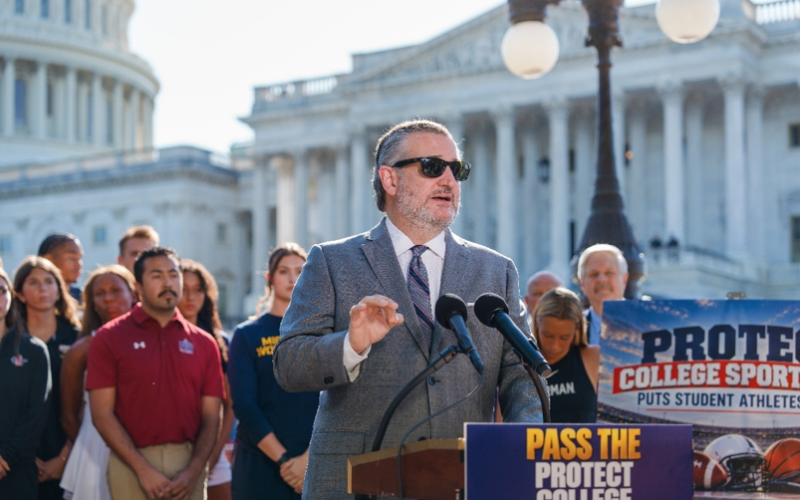

Five days after the SWAC wrote Congress in support of the Protect College Sports Act, the Mid-Eastern Athletic Conference did the same. MEAC Commissioner Sonja O. Stills signed the letter on June 15 on behalf of the conference’s eight schools. Both conferences back the bill. On the two issues the MEAC calls most important, the two letters are not making the same ask.
Where They Agree
Both the SWAC and the MEAC support the bill and frame their letters as offers to help improve it rather than as opposition. Both also flag employee classification and revenue sharing as areas that need to be fixed before the bill is ready. We covered the SWAC’s letter and the broader politics of the bill when SWAC Commissioner Charles McClelland sent his on June 10. His letter called employee classification “an issue the HBCU community has consistently raised” and said the bill’s silence on it was a critical gap. The MEAC’s letter goes further.
On Employee Classification, the MEAC Wants a Specific Fix
The SWAC said Congress needed to address the fact that the bill does not state whether athletes are employees. The MEAC says exactly what it wants done about it: the bill should be rewritten to explicitly state that student-athletes are not employees.
The MEAC’s reasoning is straightforward. If athletes were classified as employees, schools would have to pay them wages, cover benefits, and carry workers’ compensation. For the eight MEAC schools, including Coppin State, Delaware State, Howard, Morgan State, Norfolk State, North Carolina Central, South Carolina State, and the University of Maryland Eastern Shore, that cost does not fit the budget. UMES does not even sponsor football. If the money to pay football and basketball players had to come from somewhere, it would come from the same pool that funds women’s sports, track, soccer, and everything else. The MEAC says that would force schools to cut those programs.
The SWAC made the same argument in general terms. The MEAC is asking Congress to put a specific answer in the law.
On Women’s Sports, the Two Letters Go Different Directions
This is the clearest difference between them. The SWAC’s letter did not raise women’s and Olympic sports protections. The MEAC calls them the second of its two most important issues.
The bill’s current protections for women’s and Olympic sports only apply to schools that join a pooled media rights arrangement the legislation would create. Schools that do not join would not be covered. The MEAC says every Division I school should be covered, and proposes that Congress require every Division I program to sponsor at least 14 or 16 sports as a universal baseline.
The practical issue is that many MEAC schools are unlikely to join a large pooled media deal. If protection for women’s sports depends on that participation, it does not really protect them. UMES fields no football program. For a school built around non-revenue sports, the question of who these protections apply to is not a minor technical point.
On Revenue Sharing, the MEAC Gets More Specific
Both conferences flagged problems with the bill’s revenue-sharing provisions. The MEAC’s letter lays out what it wants changed. Under the current bill, when a school pays an athlete directly, the payment must pass a test to determine whether it reflects fair market value and serves a legitimate business purpose. The MEAC says those requirements should not apply to direct revenue-sharing payments. It also says payments from outside parties, like a company paying an athlete for an endorsement, should not count against the school’s revenue-sharing cap.
The letter also asks that the bill’s anti-cheating language be tightened so that it catches only actual cap evasion and pay-for-play schemes, not ordinary participation in revenue sharing. And a separate prize-money provision should be brought in line with the bill’s other compensation rules so that athletes cannot use it as a backdoor to earn beyond what the bill intends.
What the MEAC Raised That the SWAC Did Not
The MEAC’s letter covers several areas the SWAC’s did not touch.
On lawsuits: the bill currently allows athletes, schools, and others to file claims in state or federal court over violations of the new rules. The MEAC says that provision is too broad and should be either narrowed significantly or moved to federal court only. As the letter puts it, citing language the bill’s own authors have used, giving thousands of state and federal judges authority to hear these cases independently “would invite only more chaos.”
On enforcement: the MEAC asks that the bill expressly override state laws that would block the reporting, investigation, or punishment of NCAA rule violations. Without that, a state could effectively shield schools from consequences for breaking the rules.
On health and safety: the MEAC asks Congress to replace the terms “CTE” and “cognitive impairment” in the bill’s health provisions with the phrase “repetitive head trauma.” The MEAC’s argument is that the current terms are too narrow and leave out a range of brain injuries that the bill should cover.
On transfers: the bill currently writes transfer windows into the law itself. The MEAC says the NCAA should be allowed to set those windows by sport and adjust them as schedules change, rather than having dates fixed in federal statute that would require an act of Congress to update.
On governance: the bill requires that all athlete representatives on oversight bodies be fully independent of schools and conferences. The MEAC says only a portion of those seats need to meet that standard, which would allow some representatives with firsthand experience inside programs to participate.
One Line Worth Noting
Before getting to its legislative requests, the MEAC’s letter pauses to praise the Congressional Black Caucus for its work on redistricting. “Protecting opportunity, in the classroom, in competition, and at the ballot box, reflects the very mission our institutions were built to serve,” it states.
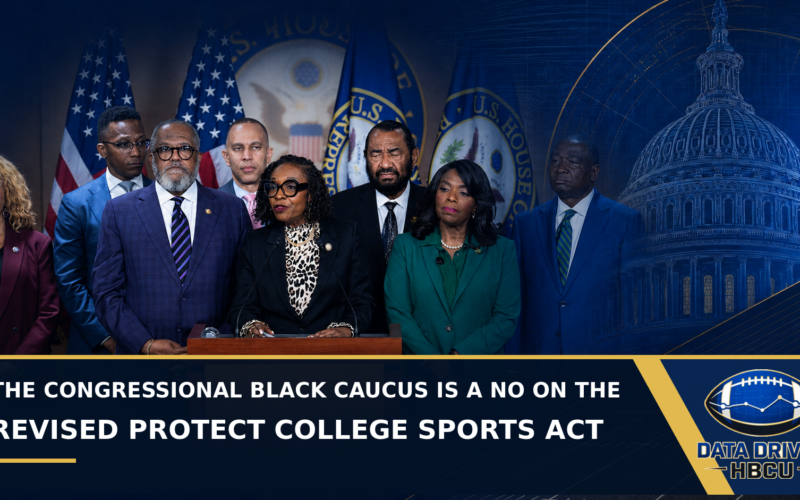
The CBC has told Congress to pause the bill until college athletics leadership engages on concerns about Black political representation. The MEAC backs the bill and praises the CBC’s redistricting work in the same letter. The SWAC’s letter did not address the CBC or redistricting at all.
Where Things Stand
Two HBCU conferences have now written in support of the bill. On the foundation, they agree. On what needs to change, the MEAC’s list is longer and more specific. Both letters call employee classification and revenue sharing critical gaps. Beyond that, the letters diverge. The SWAC did not address protections for women’s and Olympic sports, the lawsuit provision, gaps in state law enforcement, health and safety language, or transfer windows. The MEAC raised all of them, with specific changes it wants to see in each area.
The MEAC also did something the SWAC did not: it acknowledged the Congressional Black Caucus directly, praising its redistricting work in the letter’s opening before getting to any of its legislative requests. The CBC has asked Congress to pause the bill until college athletics leadership responds to its concerns about Black political representation. The MEAC is backing the bill and praising the CBC in the same document. Whether that gesture moves anything is unclear, but it reflects a political awareness that the SWAC’s more focused policy letter did not show.
A Senate Commerce Committee vote is expected before the fall season begins. The CBC has not closed the door on the bill, but college athletics leadership has not yet responded to the caucus’s request. Both HBCU conferences have now made their positions clear. Whether the version of the bill that reaches the floor includes what the MEAC is asking for will determine whether that support holds.
This Senate Committee will host a markup session on June 18th.