
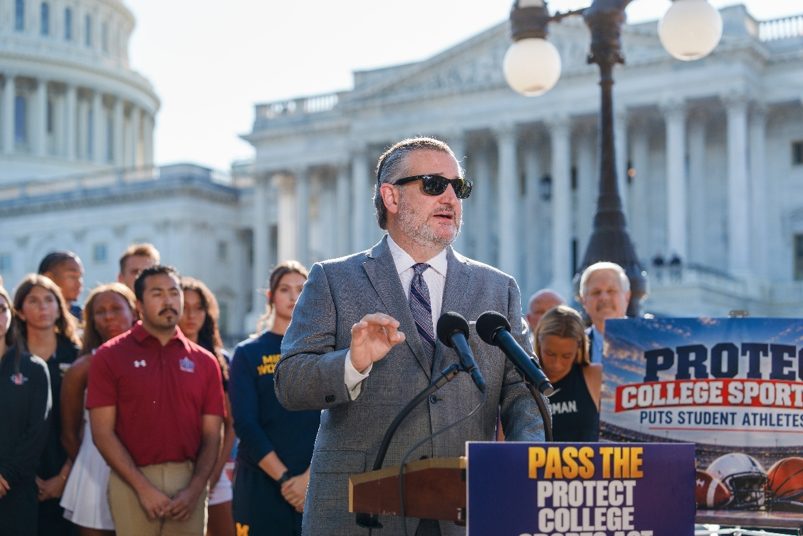
The House released its own text of the Protect College Sports Act on Friday. It does not touch the provision this series called the fight to watch. Section 122, the language that keeps the bill neutral on whether college athletes are employees, reads word for word the same as the version the Senate passed 77-22 on Sept. 28.
The House text, posted as Rules Committee Print 119-42, is a full replacement for the Senate bill. Data Driven HBCU compared the two versions word by word. Most of the bill is identical. The differences that matter for HBCUs come down to one new section on student athletic fees, a narrower rule on who can sue, a clarification on what counts against the revenue share cap, and a reshuffled list of who appoints the commission that will study the future of college sports.
Everything written specifically for HBCUs survived untouched, including the $1.08 billion Title III grant program and the two HBCU seats on that commission.
Section 122 Stayed Neutral
The Senate passage breakdown identified House Majority Leader Steve Scalise’s push to replace Section 122 with an outright ban on classifying athletes as employees as the change most likely to reshape the bill’s HBCU stakes. The House text does not include it. The section still says the title “is neutral on, and does nothing to alter, employee or non-employee status for student athletes.”
That leaves both sides of the HBCU split where they were. The SWAC and the MEAC, which asked Congress for a ban, did not get one. The NAACP and the Congressional Black Caucus, which wanted athletes to have more leverage, also did not get new rights. The commission the bill creates is still tasked with studying collective bargaining and employment status, so the question remains open rather than settled by statute.
The New Section: Student Athletic Fees
The largest addition in the House text is Section 130, aimed at the revenue source HBCU athletic departments rely on most. It has two parts.
The first is disclosure, and it would reach every school that files the federal athletics disclosure report, including Division II schools. Starting with the 2027-28 academic year, each school would have to report:
- The total amount of student fees charged to support athletics.
- How those fees are used, broken out across facilities, operating expenses, scholarships, payments to athletes, and coach and staff salaries.
- The share of the athletic program’s total cost that fees cover.
Schools would have to post that information on a public website by Oct. 15, after each fiscal year ends. The general consumer information schools already give students would also have to state how much of their fees go to athletics.
The second part is a ban, but only at the top. Starting in 2029-30, schools would average their athletics media rights revenue over the preceding two years. A school averaging $50 million or more could not use student fees for athletics the following year. The section also renames the “broadcast revenues” line in federal athletics reporting to “media rights revenues,” covering streaming and digital distribution.
No HBCU is anywhere near the ban. In 2024-25, total athletics revenue at every Division I HBCU was under $27 million, from all sources combined.
The disclosure rule is a different story. Across the 19 public Division I HBCUs in the 2024-25 athletics financial data, student fees supplied $69.4 million of $279.4 million in total revenue, about 24.8 percent. At some schools, the share is far higher:
| School | Student fees | Total athletics revenue | Fee share |
|---|---|---|---|
| Morgan State | $10,572,042 | $13,762,286 | 76.8% |
| Coppin State | $1,797,297 | $3,450,390 | 52.1% |
| NC A&T | $10,742,682 | $22,466,961 | 47.8% |
| Jackson State | $6,181,801 | $15,571,763 | 39.7% |
| Norfolk State | $9,651,929 | $24,980,261 | 38.6% |
| All 20 public Division I HBCUs | $69,395,271 | $279,351,484 | 24.8% |
Schools already report fee totals in their NCAA financial filings. Section 130 adds a public, school-posted breakdown of where the fee money goes, on a fixed annual deadline, for students who pay it.
Only Athletes Could Sue
The Senate text lets “a person” sue over violations of the bill’s listed athlete protections, in state or federal court. The House text changes that to “a current or former student-athlete,” both in the lawsuit section and in its 30-day notice requirement. The list of protections athletes can sue over, the court options and the notice-and-cure rule are otherwise unchanged.
That moves partway toward one of the MEAC’s June requests. When the MEAC backed the Protect College Sports Act in June, it objected that the bill let athletes, schools and others all file claims, and asked Congress to narrow that or limit it to federal court. The House narrowed who can file. It did not move those claims to federal court only.
Booster Deals Count Against the Cap, in Writing
The House adds a clarification to Section 114. Every name, image, and likeness deal between an athlete and a school, its employees or volunteers, a conference, or an associated entity counts against the school’s revenue share cap and its retention fund. Associated entities are a broad category that includes collectives and anyone who has given more than $50,000 to a school’s athletics program.
The MEAC had asked that payments from outside parties not count against the cap. Independent third parties, such as a national brand paying for an endorsement, are still not on the list. But the House text makes explicit that booster and collective deals do count.
Who Appoints the Commission
The Congressional Commission on the Future of College Athletics stays at 24 members, and the two HBCU seats are unchanged: one appointed by the Senate majority leader, one by the Speaker of the House. The two mid-sized conference seats are unchanged too.
What changed is the committee appointments. The Senate text gave four appointments each to the chair and ranking member of Senate Commerce and House Energy and Commerce, in consultation with the education committees. The House text gives two appointments each to the chair and ranking member of four committees:
- Senate Commerce
- House Energy and Commerce
- House Education and Workforce
- Senate Health, Education, Labor and Pensions
The education committees now appoint directly, and they also receive the commission’s reports.
What the House Left Alone
For HBCUs, the list of what did not change is as important as what did. All of the following are identical in the House text:
- Title III. The HBCU Sports Media and Connectivity Program still authorizes $180 million a year for fiscal years 2027 through 2032, up to $1.08 billion over six years. It is still an authorization, not guaranteed funding. Grant rules, priorities, and the comment period that must happen before any application is accepted are word for word the same.
- Women’s and Olympic sports. Division I sport sponsorship minimums still cannot be lowered. Scholarship and roster floors still apply only to schools with at least $50 million in athletics revenue, a line no Division I HBCU approaches. The highest 2024-25 total among the 23 Division I HBCUs is Howard’s $26.3 million.
- Medical coverage. The post-career fund keeps its $20 million threshold, $60 million minimum, and $100 million cap. Howard, Norfolk State, Morgan State and NC A&T were above $20 million in 2024-25.
- The pooled media entity. The 15 percent equal share is still reserved for schools that played in the Football Bowl Subdivision in 2024-25, which excludes every football-playing Division I HBCU. The local broadcast guarantee still runs only through that entity.
- Antitrust protection, preemption and transfers. The provisions the NAACP and the Congressional Black Caucus objected to are unchanged.
Other Changes
Several House changes are smaller or aimed elsewhere:
- The annual report each Division I school files on its sports programs no longer has to include total pay for each program’s personnel or the average hours athletes spend on athletics.
- Athletic staff could stop an athlete’s job, internship, or volunteer work if it conflicts with class time or competition-related events. The Senate text limited that to mandatory class time and mandatory events.
- If the NCAA settlement that set the revenue share cap expires or ends, Congress can vote to keep the cap in place. The House text requires that resolution to start in the Senate and drops the expedited House procedures for it.
- Conference consolidation limits now apply to conferences reporting more than $600 million in revenue, down from $700 million, and the limit on how many schools those conferences can grow to rises from 20 to 22.
- Annual reports on foreign money in college athletics would also go to the two education committees.
Where the MEAC’s Asks Stand Now
Here is how the MEAC’s June requests fare in each chamber’s text.
| MEAC ask (June) | Senate text | House text |
|---|---|---|
| State explicitly that athletes are not employees | Not adopted | Not adopted |
| Women’s and Olympic sports protections for every Division I school | Partly | Partly, unchanged |
| Exempt direct school payments from the fair market value test | Adopted | Adopted |
| Keep outside endorsement money from counting against the cap | Partly | Partly; booster and collective deals now explicitly count |
| Narrow lawsuits or move them to federal court only | Partly | Partly; only athletes can sue |
| Replace “CTE” and “cognitive impairment” with “repetitive head trauma” | Not adopted | Not adopted |
| Let the NCAA set transfer windows | Partly | Partly, unchanged |
| Require only some athlete board seats to be fully independent | Not adopted | Not adopted |
What Comes Next
The House Rules Committee may meet the week of Nov. 30 to set up floor consideration. House members who want to offer amendments must submit them by noon Wednesday, Nov. 25, so the text could still change before a vote.
If the House passes its version, it goes back to the Senate, which would have to accept the House changes or negotiate a final version before the current Congress ends Jan. 3. A new fee disclosure rule would also put one of their largest revenue sources on a public website every year.