
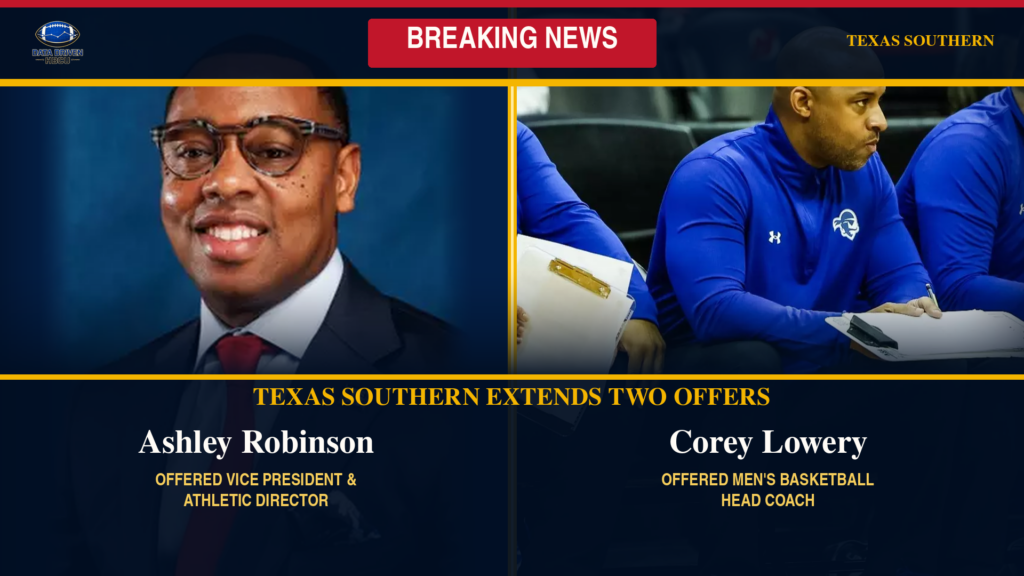
After five months, two departed leaders, a rejected recommendation, a player-led rally and a president’s office standoff that spilled into public view, Texas Southern University’s search for new athletics leadership is over. The Board of Regents confirmed Wednesday, Aug. 19, that Jackson State vice president and director of athletics Ashley Robinson will become TSU’s next athletics director, and Seton Hall assistant coach Corey Lowery will take over the men’s basketball program, closing a search that at times looked like it might not close at all before the season. But the vote itself, taken during a special called meeting, was less tidy than the outcome suggests: Robinson’s confirmation passed 5-2, a division board officials did not otherwise address on the record, and administration was more candid about the vetting process than it has previously been in public.
Both hires are set to be introduced publicly at a press conference Texas Southern has scheduled for 2 p.m. CST today, Aug. 19, with President Crawford, members of the Board of Regents, Robinson and Lowery.
The Vote: Not Unanimous
The board approved both hires by voice vote, with Personnel and Litigation Committee chair Regent Paloma Ahmadi presiding over each motion. For Robinson’s appointment as vice president and athletics director, the roll call was announced simply as carried, with aye votes and no opposition or abstentions spoken aloud, before board staff added, for the record, that the actual tally was 5-2. Neither the dissenting regents nor their reasoning were identified during the portion of the meeting reviewed by Data Driven HBCU. Lowery’s appointment as head men’s basketball coach, voted on immediately after, was also gaveled through as carried with no comparable “for the record” breakdown announced, suggesting a different, less contested outcome for that item, though the university has not confirmed whether that vote was unanimous.
Ashley Robinson, Athletics Director
Vice President for Athletics and University Advancement Dr. Ronald McKinley presented Robinson’s appointment to the board, describing a career that extends beyond his current post at Jackson State. Per McKinley’s presentation, Robinson has been a vice president for the last 15 years, a stretch that includes his current role as athletics director at Jackson State University, an earlier stint as athletics director at Mississippi Valley State University, two separate periods leading Prairie View A&M’s athletics department, and a role as assistant commissioner of the Southwestern Athletic Conference. Outside reporting has previously credited Robinson with more than two dozen conference and national championships across Jackson State’s athletic programs, three SWAC football titles in a four-year stretch, the 2024 Celebration Bowl, and the high-profile 2020 hire of Pro Football Hall of Famer Deion Sanders as football coach. He was inducted into the SWAC Hall of Fame in 2025 and has family ties to Houston.
Corey Lowery, Head Men’s Basketball Coach
McKinley’s presentation of Lowery’s background is worth reading carefully against what has already been reported about him. According to McKinley, Lowery has 21 years of coaching experience, 12 of them as a head coach, with 10 of those 12 seasons earning him a conference Coach of the Year award and an overall head-coaching winning percentage McKinley cited as .784. McKinley listed his head-coaching stops as Lincoln University, Essex College and Middlesex College, with assistant-coaching stints at Bloomfield College and, currently, Seton Hall, plus a stretch as director of player development at St. Peter’s University.
That account differs in specifics from prior reporting on Lowery’s résumé, which described two seasons as head coach at Lincoln University in Pennsylvania (capped by a single CIAA Coach of the Year honor for 2021-22) and six seasons at Essex County College with conference titles but no comparable count of Coach of the Year awards, and did not previously mention Middlesex College or Bloomfield College. The gap matters here specifically because Lowery’s candidacy was already shadowed by reporting that his Seton Hall staff biography omitted a stint as a New Jersey high school principal that ended with him on administrative leave, and by sources describing possible NCAA rules questions stemming from his contacting Texas Southern players before any hire was approved.
How TSU Got Here
Asked by a regent to walk through the process publicly, President J.W. Crawford III laid out a timeline dating to Johnny Jones’s resignation as head basketball coach on April 23. The university then posted the executive search with an executive search firm for a legally required minimum of 14 days; DHR Global was selected as the top-ranked respondent on May 21 and formally engaged on June 3 to run both the athletics director and basketball coach searches simultaneously. Outreach and candidate recruitment ran from mid-June through July 1; DHR representatives visited campus for stakeholder meetings on June 23-24; and candidate assessment and interviews followed from July 2-15.
On July 16, Crawford convened an internal advisory committee, one coach, one dean and a sitting Division I athletics director from outside the SWAC, to review six candidates submitted for each job. DHR Global conducted due diligence and background review from July 16-31, alongside 10 virtual interviews for the athletics director post, narrowing to 4 in-person athletics director finalists and 4 in-person men’s basketball finalists interviewed in the following days. The university publicly announced it had identified candidates to submit to the board on Aug. 11, and the formal committee process, Personnel and Litigation, then Athletics, began Aug. 17, two days before Wednesday’s vote.
A Board on Notice About Alumni and Students
Before either vote, more than one regent used their floor time to put the administration on notice about future searches rather than relitigate this one. One regent said alumni and students are “major constituencies” who need to be “well represented” in decisions about “critical leadership positions,” a comment made with National Alumni Association president Donald Greer seated in the room and acknowledged by the board chairman earlier in the meeting. Another regent, speaking before the Lowery vote, said future searches for critical leadership positions should “strongly include” faculty, staff, students and alumni. Neither regent connected the comments explicitly to Tuesday’s player-and-student rally for interim coach Shyrone Chatman or the alumni campaign for Tony Wyllie, but the timing made the subtext difficult to miss.
What’s Left to Watch
Lowery inherits a roster assembled largely by Chatman, who spent the offseason recruiting through the transfer portal and building the non-conference schedule as interim coach. How much of that staff and roster stays intact under a new head coach, with the season opener roughly three months out and fall classes already underway, is the next storyline for a program that has had more headlines about its leadership than its lineup this offseason. So is the question the board itself raised but didn’t fully answer Wednesday: what specifically drove two regents to vote against Robinson’s confirmation, and whether Lowery’s coaching record, as presented to the board, holds up to the same scrutiny his background already has.