
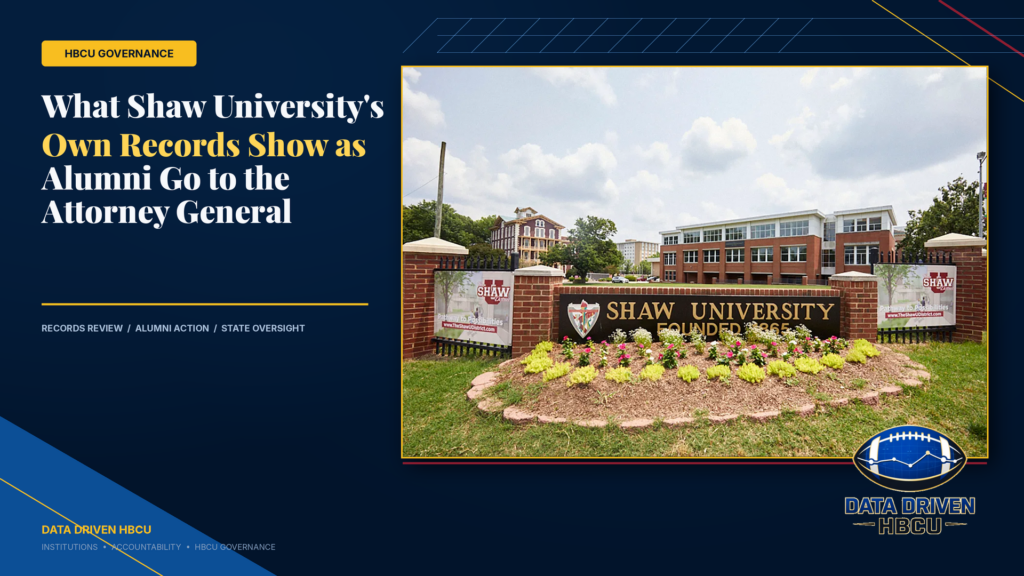
On Thursday morning, a group of Shaw University alumni and supporters gathered at the corner of Wilmington and South Streets, directly across from campus, to announce that the Save Our Shaw coalition has filed a formal complaint with the North Carolina Attorney General’s Office.
“We did not want it to come to this,” the coalition wrote in its press conference announcement. “But after years of asking questions about Shaw’s finances, property sales, governance and the future of our campus, we still do not have the transparency we have repeatedly asked for.”
The complaint itself has not been made public. Data Driven HBCU has requested a copy through a public records request to the North Carolina Department of Justice.
What is public is a long paper trail. Data Driven HBCU reviewed Shaw’s audited financial statements, its federal athletics and enrollment reports, Wake County court and property records, and Raleigh city records from the 2022 and 2023 campus rezoning. Taken together, they show a university that told the public in 2023 how it planned to use its land to stabilize its finances, and a record since then that answers some of the coalition’s questions and leaves others open.
What the Coalition Says
The coalition lists four concerns: Shaw’s finances, its property sales, its governance, and the future of its campus. It also says Shaw has never publicly presented a comprehensive master plan, and that “Shaw’s own audits have raised serious questions that deserve answers.”
Eugene Myrick, a 1994 Shaw graduate and the founder of Save Our Shaw, opened Thursday’s press conference by describing the filing as a complaint “regarding the governance issues of Shaw University.” He said the stakes reach beyond the campus. “This is about the community of Raleigh on a greater scale,” he said.
Preservation advocate Chris Cruz framed the responsibility in plain terms. “The trustees owe sound fiscal management,” he said, calling on the trustees, alumni and the city to build a plan to maintain the campus’s historic buildings.
The livestream recording reviewed by Data Driven HBCU ended before Myrick laid out the specifics of the complaint. The coalition also said several members planned to head to bankruptcy court afterward to stand with Saint Augustine’s University.
Myrick’s concerns are not new. In 2023, he spoke against Shaw’s campus rezoning at the Raleigh Planning Commission and at all three City Council hearings on the case.
The Plan Shaw Described in 2023
The records tell a story that starts with that rezoning. In 2022, Shaw asked the City of Raleigh to rezone 17 parcels covering 26.53 acres, nearly all of its downtown land, for high-rise, mixed-use development. The request originally sought heights of up to 30 and 40 stories. City staff estimated the change could roughly double the number of homes allowed on the land, before Shaw later lowered the requested heights in parts of the site.
At a November 2022 neighborhood meeting, Shaw’s representatives were asked whether the redevelopment would include a football stadium. The response, as recorded in Shaw’s report to the city: “The master plan will consider location of facilities and such planning will occur after the rezoning.” Asked how the rezoning would help students, they pointed to “new residence halls and an athletic complex.” Asked about notice to alumni and students, they said: “The University intends to run a transparent process.”
When President Paulette Dillard presented Shaw’s case to the City Council on ApriApril 423, her list of student needs included new residence halls, a replacement student center, a new library, athletic and recreation facilities and a stadium. Shaw’s presentation put its deferred maintenance at $26.1 million.
The opposition was large. The mayor sorted those who signed up to speak into four groups: alums, members of the Muslim community, preservationists and neighbors. The Raleigh Historic Development Commission recommended denial, 9 to 2.
At the May 2 hearing, Shaw’s attorney addressed fears that the university could sell its land, telling the council that a long-term land lease could keep the land under Shaw’s control. At the same hearing, Council Member Christina Jones said she had read all 600 emails the council received on the case and that the writers felt they were not part of the conversation.
In June 2023, the council approved the rezoning 5 to 3, with Council Members Megan Patton, Mary Black and Christina Jones voting no. Before the vote, Shaw signed additional conditions. Its first three new buildings must include at least 100 beds of student housing. It must hold public meetings to update the community on development for three years after it submits its first site plan. It must also file a rezoning petition if it sells any of the property.
The next day, Shaw announced the approval and quoted Dillard describing The ShawU District as “owned and controlled by the University.”
Four months later, Kevin Sullivan, Shaw’s vice president for real estate and strategic development, laid out the approach in an interview with Open Campus. “We have no intention of selling our land,” he said. “Instead, we plan to develop it ourselves with long-term partners who share our mission.” The article noted that the rezoned land had been valued at $160 million to $270 million as of 2019.
Where the Master Plan Stands
Shaw did start the master plan process. In July 2023, it issued a request for qualifications for the ShawU District Master Plan, a 10-year plan for its roughly 27 downtown acres. The request said the planning process should take no more than 12 months and called for “extensive community engagement activities, including public meetings, workshops, and surveys.”
In October 2023, Sullivan said Shaw was “only now at the beginning of hiring an architectural/planning firm” to create the plan.
Nearly three years later, the coalition says no comprehensive master plan has been publicly presented. None of the records reviewed for this story show whether the university hired a firm or completed a plan.
The Money
The financial records explain why Shaw described the redevelopment as a path to stability. In the Open Campus interview, Sullivan said the goal was to create “new revenue sources that are not just tied to tuition.”
| Measure | 2023-24 | 2024-25 |
|---|---|---|
| Operating revenue | $28.97M | $30.77M |
| Operating expenses | $38.11M | $34.53M |
| Operating loss | ($9.14M) | ($3.76M) |
| Net tuition and fees | $7.96M | $9.48M |
| Loans and line of credit owed | $11.24M | $20.76M |
| Interest expense | $326K | $875K |
| Cash at year-end | $100K | $3.22M |
The operating loss shrank by about $5.4 million in 2024-25. Net tuition rose 19 percent as enrollment grew and Shaw gave back less in discounts: university-funded scholarships fell from about 44 percent of gross tuition to about 35 percent.
The improvement came alongside heavier borrowing. Shaw’s debt nearly doubled in one year, to $20.8 million. In June 2025, it signed a loan agreement with Self-Help Ventures Fund for up to $20 million at a fixed 9 percent rate, maturing in 2035, to cover working capital deficits, refinance loans, and pay for future capital projects. About $6 million had been drawn by the end of June 2025.
Shaw’s securities-backed line of credit was fully drawn at $8.7 million, with nothing left to borrow. The university was out of compliance with covenants on both of its loans and obtained waivers from its lenders.
University-wide support, which covers administration, accounted for more than half of Shaw’s 2024-25 operating spending. Instruction accounted for about 16 percent.
The Endowment and Financial Controls
The audits also document the kinds of governance problems the coalition is pointing to.
Shaw’s audit for the 2023-24 school year found that after the board approved the securities-backed line of credit, the university’s former chief financial officer moved the proceeds “without the knowledge of the President or the Board of Trustees.” The money was used to pay obligations to employees and outside parties.
The same audit found that about $1.4 million in donor gifts intended for the endowment were instead spent on operations, without the president’s or the donors’ knowledge and without board approval. The auditors list both findings as corrected in 2024-25.
In 2024-25, another $815,425 in endowment gifts went to operations rather than being invested. Shaw records the money as a loan from its own endowment and owes $2.18 million back, with repayments scheduled to begin in 2026-27.
Endowment funds that have fallen below the value of their original gifts totaled about $3.06 million. In March 2025, the board authorized borrowing up to $14 million from the endowment to meet urgent cash needs. None had been drawn as of the December 2025 audit report.
Shaw’s federal student aid compliance audit for 2024-25 found five problems in how it handles aid; four of them are repeats from the year before.
The Land
Property records are where rezoning and finances meet.
Eight days after the council approved the rezoning, Shaw signed a $6.5 million loan with Mechanics and Farmers Bank. The loan is secured by two of the newly rezoned parcels: the main campus at 118 E. South Street and the Talbert O. Shaw Dormitories at 301 E. South Street. Shaw’s audit says the loan refinanced its earlier lines of credit.
In June 2025, Shaw pledged far more. The deed of trust securing the Self-Help loan, signed by board chair Joseph Bell and Dillard, covers 19 tracts. Those include all 17 parcels in the 2023 rezoning, 300 E. South Street, and a 34.76-acre property on Rock Quarry Road. The Rock Quarry Road property had come up at both a 2022 neighborhood meeting and the April 2023 council hearing, where Myrick showed photos of it in disrepair.
In July 2026, a satisfaction of that deed of trust was recorded with the Wake County Register of Deeds, which typically releases the lien. The audit, issued in December 2025, described the loan as running to 2035. None of the records reviewed for this story show how the loan was repaid, refinanced, or otherwise resolved.
Two other 2025 records involve campus property.
In April 2025, contractor MSS Solutions filed a $2,194,155 lien against the Talbert O. Shaw dorms for replacing their chilled water HVAC system. The lien was canceled in December 2025, and the cancellation does not say why, and the audit does not mention it.
In May 2025, Shaw signed a quitclaim deed returning to the State of North Carolina a parcel the State had conveyed to it in 1970. The 1957 survey of that land is titled “Property to be Acquired for Shaw University Stadium,” and the conveyance required the land to revert to the State if Shaw stopped using it for athletic, educational, and recreational purposes. The deed states that Shaw “did not utilize the Property for athletic, educational, and recreational purposes and title reverted to Grantee many years ago.”
On sales, Shaw’s audits report $1.4 million in proceeds from property sales in 2023-24 and $409,000 in 2024-25. The only sale deed found in the Wake County records reviewed for this story is a 0.20-acre landlocked lot on Latta Street, sold in December 2023 for about $150,000 based on the excise tax recorded. That lot was not part of the rezoned campus. The remaining reported proceeds could not be matched to a property.
| Date | Record |
|---|---|
| June 20, 2023 | Raleigh City Council approves rezoning of 17 campus parcels, 5 to 3 |
| June 28, 2023 | $6.5 million Mechanics and Farmers Bank loan secured by main campus and dorms |
| July 25, 2023 | Shaw seeks firms for The ShawU District Master Plan |
| October 26, 2023 | Shaw says it has “no intention of selling our land” |
| December 13, 2023 | Shaw sells 0.20-acre Latta Street lot |
| April 4, 2025 | $2.19 million contractor lien filed on Talbert O. Shaw dorms |
| May 29, 2025 | Stadium land deed returned to State of North Carolina |
| June 18, 2025 | Deed of trust for $20 million Self-Help loan recorded on 19 tracts |
| December 2, 2025 | Contractor lien canceled |
| July 27, 2026 | Satisfaction of Self-Help deed of trust recorded |
| October 1, 2026 | Save Our Shaw announces Attorney General complaint |
Where Athletics Fits
Athletics runs through this story in two ways: the facilities Shaw promised and the role sports play in Shaw’s enrollment.
A stadium and athletic facilities were on Shaw’s list of student needs when it sought the rezoning. Three years later, no new athletic facility appears in the records reviewed for this story, and the land the State once provided for a Shaw stadium has formally gone back to the State.
Meanwhile, athletes make up a large share of the student body. In 2024-25, according to Federal EADA reports obtained by Data Driven HBCU, Shaw had 298 varsity athletes among 821 full-time undergraduates, roughly one in three students, including 111 football players. Shaw’s published tuition and required fees that year were $17,538. At that price, its athletes represent about $5.23 million in tuition and fees before any discounts, roughly 36 percent of the $14.69 million in gross tuition and fees Shaw recorded.
Shaw awarded $2.53 million in athletic scholarships, averaging about $8,480 per athlete, or a little less than half of published tuition.
Football makes the math easiest to see. Division II programs are limited to 36 scholarship equivalencies in football, and those equivalencies can be divided into partial awards across the roster. Shaw does not publish how it distributes its football scholarships or how many equivalencies it funds, so what follows is a hypothetical, not reported data.
If Shaw funded the full 36 equivalencies and applied them to tuition, they would cover about $631,000. Spread evenly across 111 players, that works out to about $5,690 per player, leaving the average player billed about $11,850 in tuition. Across the roster, that would be roughly $1.32 million in net tuition.
That approach mirrors the model laid out in Edward Waters Turns Down Division I Paydays and Explains Why Football Already Pays for Itself, where a large roster on partial scholarships generates more tuition than the program costs to run. The Delta Devils Run Lean. The Data Shows What That Costs. shows the same scholarship ceiling at a Division I school whose football scholarship count matches the Division II maximum.
Whatever the actual split, the published tuition tied to Shaw’s football roster, about $1.95 million, exceeds the program’s total reported cost of $1.30 million, which includes scholarships, coaching salaries, and game-day expenses. Across all sports, athlete tuition at the published rate exceeds the $4.40 million spent directly on teams, but falls about $276,000 short of the full $5.50 million athletics total once $1.10 million in department-wide costs are included. None of these figures count housing and meal revenue from athletes who live on campus, or other aid that lowers what some athletes pay.
At a school where one in three full-time undergraduates is an athlete, that math suggests athletics could be one of Shaw’s most direct enrollment tools, adding weight to the athletic facilities Shaw listed among its needs in 2023.
What Has Improved
The records also show progress. Shaw’s audit reports enrollment growth in 2024-25 and again in fall 2025. Net tuition and housing revenue rose.
Bad debt expense fell from $2.2 million to $416,000 as Shaw adopted a stricter collection policy. The operating loss was less than half that of the prior year. The 2024-25 financial statements received a clean audit opinion with no financial statement findings.
Shaw also received $89,600 in National Park Service funding in 2024-25 for work on historic campus buildings, including Leonard and Estey Halls, consistent with Sullivan’s 2023 statement that the university had secured such funding.
What Remains Unanswered
Several questions raised by the records cannot be answered from public documents alone:
- Whether Shaw hired a firm for The ShawU District Master Plan, and whether a plan exists
- How the Self-Help loan secured by the campus was satisfied in July 2026
- Which properties produced the $1.4 million in sale proceeds Shaw reported for 2023-24
- Whether the $2.19 million contractor lien on the dorms was paid, settled, or waived
- Whether Shaw has signed any ground lease or development partnership for the rezoned land
- What the Save Our Shaw complaint specifically alleges
In 2022, Shaw told its neighbors it intended to run a transparent process. In 2023, it told the City Council a long-term lease could keep its land under its control, and told reporters it had no intention of selling. The records reviewed for this story show Shaw still held that land as of 2025, though by then nearly all of it had been pledged as loan collateral. What they do not show is the master plan Shaw said would come next. Three years after the rezoning, the people who asked for that plan at the first public hearing are now asking the state’s attorney general for answers.
Publisher’s note: Data Driven HBCU is sharing this story with Shaw University and has invited the university to respond. This story will be updated with any response.