
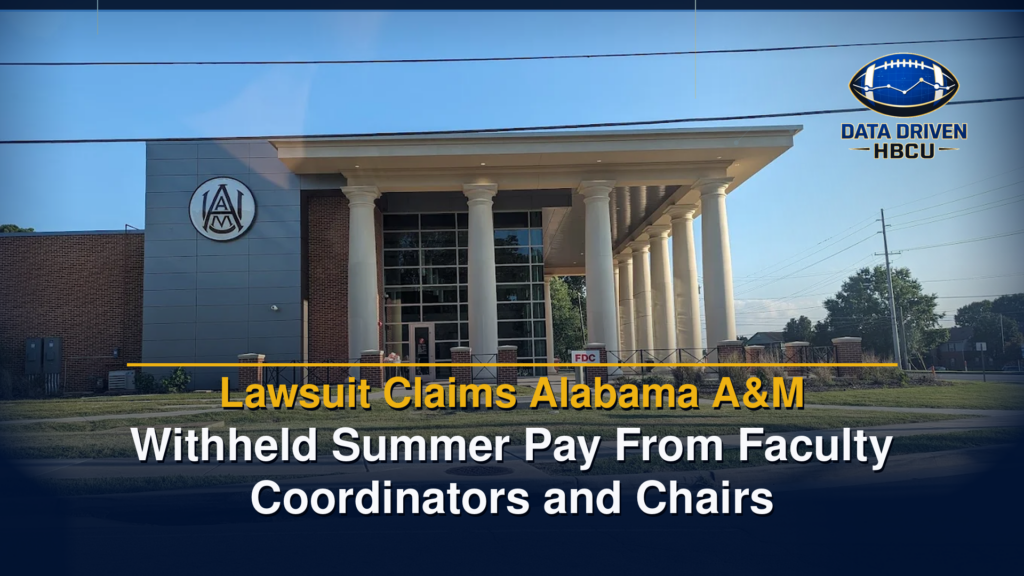
A longtime Alabama A&M University faculty member has filed a proposed class action lawsuit against the university’s president and two of its top administrators, alleging that faculty who served as program coordinators and department chairs during summer terms were not paid stipends spelled out in the university’s own faculty handbook.
According to court documents obtained by Data Driven HBCU, the complaint was filed July 31 in the Circuit Court of Madison County, Alabama, by Adrain Christopher, who court records describe as a Madison County resident who taught summer classes as a program coordinator in 2020, 2025 and the summers in between. The named defendants are Daniel K. Wims, president of Alabama A&M; Carlton Spellman, vice president for business and finance and chief financial officer; and John D. Jones, provost and vice president of academic affairs. Each is sued in both his official and individual capacity, along with up to 120 unnamed defendants, the complaint says, who will be identified through discovery.
The central claim: handbook language as a binding promise
The lawsuit turns on a specific provision of Alabama A&M’s 2018 Faculty Handbook. According to the complaint, the handbook states that program coordinators are to be paid “$1000/month for two months” and department chairs “the usual $1200/month for administrative duties” during the summer term.
Christopher alleges those amounts were never merely aspirational. Her offer of employment letter, which the complaint says was signed by Wims himself in August 2018, stated that employment would be governed by the policies of the university and its Board of Trustees, “including the Staff Handbook or Faculty Handbook (as applicable).” In the plaintiff’s telling, that language incorporated the handbook’s summer pay schedule directly into every faculty member’s employment contract. When coordinators and chairs performed summer work and were paid on some other basis, the suit contends, the university’s administrators breached those contracts.
The complaint goes a step further than unpaid wages. Because retirement contributions are calculated based on compensation, Christopher alleges that the underpayments also shorted faculty accounts in the Teachers’ Retirement System of Alabama and TIAA retirement plans. The suit asks the court to order a recalculation of the amounts that should have been contributed to those plans had the summer pay been calculated correctly.
A proposed class covering six years of summer terms
Christopher seeks to represent a class of all people who served as program coordinators or department chairs at Alabama A&M during any summer term from June 2020 through the present and were not fully compensated under the handbook’s terms. The complaint estimates the class “may number in the hundreds” and says its members can be identified from the university’s own payroll and human resources records.
The suit asserts four counts. The first seeks an injunction and writ of mandamus against the administrators in their official capacities, arguing that paying the handbook amounts was a required, ministerial act that left them no discretion. The second asserts claims against Wims, Spellman, and Jones individually, alleging that their failure to pay was fraudulent, in bad faith, beyond their authority, or based on a mistaken interpretation of the law. That framing matters: Alabama’s state immunity doctrines shield state officials from many lawsuits, but those protections have recognized exceptions for ministerial acts and for conduct that is fraudulent, in bad faith, or beyond an official’s authority. The remaining counts assert estoppel theories and preserve claims against the unnamed defendants.
Discovery served on day one
Christopher’s attorneys, F. Taylor Rouse and Austin M. Hagood of the Huntsville firm Ryan & Rouse, LLC, served a full slate of discovery along with the complaint: seven requests for admission, 30 interrogatories and 40 requests for production. The requests seek, among other things, the identity of every person who taught or coordinated a summer class from 2020 through 2026, payroll registers for every summer term in that window, the formula the university actually used to calculate summer pay, Board of Trustees materials concerning faculty compensation, and records of contributions reported to the state retirement system.
The discovery also asks the defendants to admit that the 2018 handbook was the only faculty handbook in effect during each summer from 2020 through 2025 and remains in effect today, an admission that would narrow the case considerably if granted.
The complaint states that the amount in controversy exceeds $20,000, the jurisdictional threshold for circuit court, and that class damages will be proven at trial. The plaintiff also seeks interest, costs, and attorneys’ fees.
The defendants have not yet filed a response, and the allegations in the complaint represent only the plaintiff’s side of the case. Alabama A&M itself is not named as a defendant; the claims run against the administrators and the unnamed employees alleged to have calculated and paid summer compensation.


