
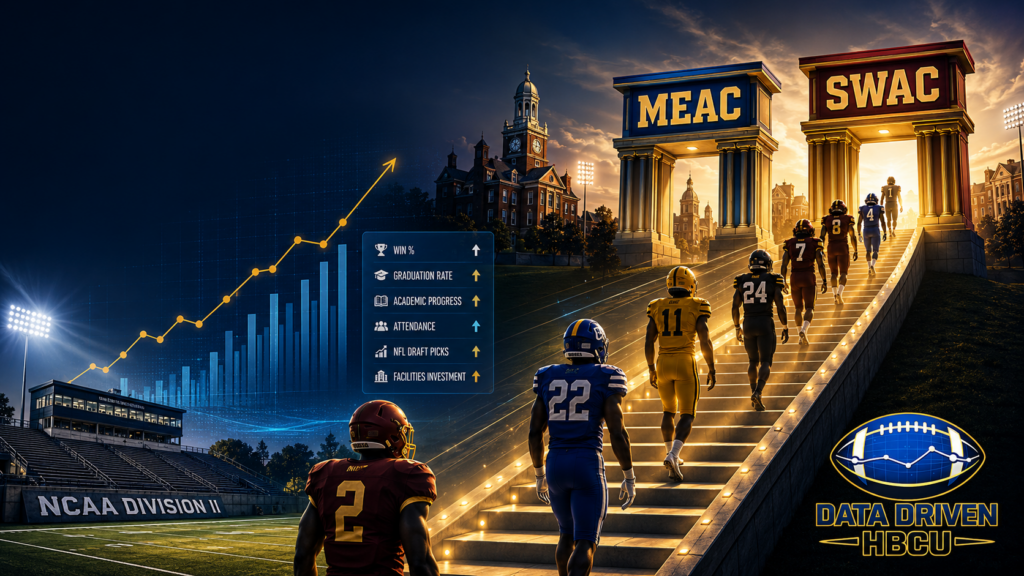
The cost of moving from Division II to Division I may soon climb sharply. On Oct. 15, the NCAA Division I Membership Committee recommended that the Division I Board of Directors introduce legislation setting the reclassification application fee at six times the estimated annual average value of the revenue distribution and championship benefits available to Division I members. Under the current rule, the fee is set at that value once.
If the board moves the proposal forward and adopts it, the new fee would take effect Jan. 20, 2027, and apply to schools that begin reclassifying in the 2027-28 school year or later. For CIAA and SIAC schools floated as future MEAC or SWAC members, it would turn the entry fee from one cost among many into the largest single expense of the move.
What the Committee Recommended
The committee said it reviewed the current standards, the effects of schools changing divisions, and data on finances and championship access after a referral from the Division I Decision-Making Working Group. It concluded that “the current application fee undervalues Division I membership.”
The six-times multiplier reflects the fewest years it takes a reclassifying school to go from entering the process to becoming fully eligible for Division I revenue distribution. In the committee’s words, the higher fee “mitigates the dilution of revenue distribution for members of the division” and “helps a reclassifying institution demonstrate its financial commitment” to Division I.
The proposal keeps the existing refund schedule. A Division II school that withdraws from the process gets back 50% of the fee through its first year and 30% through its second year. After that, there is no refund.
What the New Fee Could Look Like
The report doesn’t put a dollar figure on the new fee because the underlying value is recalculated each year. The most recent public figure is from 2023, when an NCAA legislative document put the fee for a Division II school at about $1.8 million.
If the base stays near that level, six times would be about $10.8 million. The actual 2027-28 number will depend on the NCAA’s calculation that year, so $10.8 million is an estimate, not a quoted price.
More Than a Year of Athletic Spending
Which Division II HBCUs Are Built for the Jump to the MEAC or SWAC? ranks every Division II HBCU on athletic spending for the 2023-24 school year. Virginia State led the field at $9.3 million.
Measured against those budgets, an estimated $10.8 million fee would cost more than any Division II HBCU spends on athletics in a full year. For the leading candidates, it would equal anywhere from about 1.2 to 2 years of total athletic spending.
| School | Conference | Total Athletic Expenses (2023-24) | Estimated Fee as Multiple of Budget |
|---|---|---|---|
| Virginia State | CIAA | $9,315,469 | 1.2x |
| Clark Atlanta | SIAC | $8,058,158 | 1.3x |
| Bowie State | CIAA | $7,386,532 | 1.5x |
| Winston-Salem State | CIAA | $6,733,477 | 1.6x |
| Fayetteville State | CIAA | $6,605,296 | 1.6x |
| Tuskegee | SIAC | $5,773,045 | 1.9x |
| Edward Waters | SIAC | $5,469,614 | 2.0x |
| Benedict | SIAC | $5,466,026 | 2.0x |
That fee would sit on top of the operating costs the move already carries. The NCAA’s own study of schools that moved from Division II to Division I found an average increase in athletics spending of $3.7 million a year, with only about $500,000 of it covered by new revenue.
The rest, roughly $3.2 million a year, has to come from student fees, state support, or the broader university budget. Under the proposal, a school would need to find that money every year, on top of a one-time fee larger than its current athletic budget.
The Scholarship Climb
Division II football allows up to 36 scholarship equivalencies, and several CIAA programs fund well short of that. In 2024-25, Winston-Salem State funded 30.89 football equivalencies, Virginia State funded 21.44, Elizabeth City State funded 12.7, and Bowie State funded 11.29. Edward Waters fielded 29 against Jackson State this season.
Even strong Division II programs outside the HBCU ranks sit below the cap. Gulf South Conference members Delta State and Valdosta State fielded 35.26 and 28.72 football equivalencies in 2024-25.
Division I sets a much higher bar through two rules. The first is the 56.7 rule. An FBS school can count one win over an FCS opponent toward bowl eligibility, and one game toward its FBS scheduling requirement, only if that opponent averaged at least 56.7 football grants-in-aid per year over a rolling two-year period. That figure is 90% of the traditional FCS limit of 63. For an FBS school paying a guarantee, beating a program below that line doesn’t count toward bowl eligibility.
The second is the House settlement. Schools that opt in operate under roster limits instead of scholarship caps, with a 105-player limit in football, and every one of those roster spots can carry a scholarship. Every MEAC and SWAC member has opted in, as have Hampton, NC A&T and Tennessee State. NC Central and Tennessee State opted in this school year. In 2024-25, the last year under the old caps, the median MEAC and SWAC football program funded about 62.7 equivalencies.
Using each school’s own 2024-25 cost per football equivalency, the table below estimates the added yearly cost of reaching each level. Winston-Salem State spent about $20,165 per equivalency, Elizabeth City State about $25,890, Virginia State about $28,934, and Bowie State about $39,681.
| School | Football Equivalencies (2024-25) | Added Cost to Reach 36 | Added Cost to Reach 56.7 | Added Cost to Reach 63 | Added Cost to Reach 105 |
|---|---|---|---|---|---|
| Winston-Salem State | 30.89 | $103,000 | $520,000 | $647,000 | $1,494,000 |
| Virginia State | 21.44 | $421,000 | $1,020,000 | $1,203,000 | $2,418,000 |
| Elizabeth City State | 12.70 | $603,000 | $1,139,000 | $1,302,000 | $2,390,000 |
| Bowie State | 11.29 | $981,000 | $1,802,000 | $2,052,000 | $3,719,000 |
These are yearly costs, not one-time ones, and they assume each school’s current cost per equivalency holds. Reaching 56.7 would add an estimated $1.8 million a year at Bowie State, about a quarter of its $7.4 million athletic budget from 2023-24. At Elizabeth City State, it would add about $1.1 million, roughly 28% of a $4.1 million budget. Virginia State, the top spender among Division II HBCUs, would need about $1 million more, about 11% of its $9.3 million budget. Winston-Salem State, already the closest of the four to the Division II cap, would need about $520,000 more.
Funding a full 105-man roster, the ceiling MEAC and SWAC schools can now reach, would add between about $1.5 million and $3.7 million a year at these four schools. None of these figures include the application fee.
A Fee Priced on the Division I Average
The fee is built on the average value of distribution and championship benefits across all of Division I. Under the current formula, that average was worth about $1.8 million in 2023. No MEAC or SWAC school came close to that in NCAA money.
The 2024-25 financial reports list NCAA revenue separately from conference distributions. Among the 16 public MEAC and SWAC schools in those reports, none received more than $1 million from the NCAA outside of football. Jackson State reported the most at $894,331, followed by Grambling State at $870,486 and Norfolk State at $837,521.
| School | Conference | NCAA Revenue, Non-Football (2024-25) | Conference Distributions, Non-Media (2024-25) |
|---|---|---|---|
| Jackson State | SWAC | $894,331 | $1,113,570 |
| Grambling State | SWAC | $870,486 | $250,000 |
| Norfolk State | MEAC | $837,521 | $951,608 |
| Arkansas-Pine Bluff | SWAC | $611,022 | $0 |
| Texas Southern | SWAC | $491,122 | $0 |
| Mississippi Valley State | SWAC | $486,252 | $661,602 |
| Coppin State | MEAC | $407,861 | $0 |
| Southern | SWAC | $407,826 | $495,770 |
| Maryland Eastern Shore | MEAC | $236,781 | $126,876 |
| NC Central | MEAC | $188,114 | $168,859 |
| South Carolina State | MEAC | $169,935 | $819,672 |
| Morgan State | MEAC | $164,796 | $0 |
| Florida A&M | SWAC | $116,710 | $609,504 |
| Prairie View A&M | SWAC | $8,019 | $1,259,865 |
| Median (14 schools) | $407,844 |
Alabama A&M and Alcorn State reported no NCAA revenue or conference distributions on these lines and are not included in the table. Schools also differ in how they record the money. For example, Prairie View reported $8,019 from the NCAA and nearly $1.26 million in conference distributions.
At the median of about $408,000, a new member would need about 26 years of NCAA revenue to match an estimated $10.8 million fee. Even at Jackson State’s level, the highest in the group, it would take about 12 years.
The Cost of Turning Back
Winston-Salem State is the clearest reminder that a move up can end before it is finished. The school began its transition to Division I and the MEAC in 2004, and its chancellor ended the attempt in 2009 after athletic expenses nearly doubled and the department ran about $2 million in debt.
The proposal would not change the refund schedule, but it would change the dollars at stake.
| Withdrawal Timing | Refund | Amount Lost at About $1.8M Fee | Amount Lost at Estimated $10.8M Fee |
|---|---|---|---|
| Through year one | 50% | $900,000 | $5,400,000 |
| Through year two | 30% | $1,260,000 | $7,560,000 |
| After year two | 0% | $1,800,000 | $10,800,000 |
A school that started the move and stepped back in its first year would lose an estimated $5.4 million. Stepping back in its second year would cost an estimated $7.6 million, and any later exit would forfeit the entire fee. Even the smallest of those losses is more than twice the debt that ended Winston-Salem State’s last attempt.
Public and Private Schools Face Different Math
The public candidates have the two funding sources the NCAA’s study says reclassifying schools lean on most: student fees and state support. North Carolina’s two leading Division II candidates have a third. The state’s sports wagering tax revenue guarantees Winston-Salem State and Fayetteville State a $300,000 annual floor as Division II schools, with larger shares that can push a school’s annual total toward $3.6 million reserved for the state’s Division I HBCUs.
That money still matters for the yearly operating gap. But even at the top Division I share, an estimated $10.8 million fee would equal about three years of it. At the Division II floor, it would equal 36 years.
Private candidates face a harder path. Clark Atlanta, Tuskegee, and Morehouse do not charge a separate student athletic fee and cannot draw on a state appropriation the way public schools can. A fee of this size would have to come from donors, tuition, or university-wide funds.
That includes Morehouse, whose athletic director Harold Ellis said in July, “The SWAC, the MEAC, we’re coming.” Ellis framed it as an ambition, not a plan, at the time. A school that begins the move in 2027-28 or later would pay whatever fee the NCAA adopts.
Edward Waters has already chosen a different direction. Edward Waters Turns Down Division I Paydays and Explains Why Football Already Pays for Itself lays out a model built around a large Division II roster as an enrollment pipeline for a tuition-dependent university. A larger entry fee makes that model look stronger by comparison.
The Timing
The proposal leaves the current fee in place for schools that begin reclassifying before 2027-28. But a Division II school cannot apply to move up until it has a Division I conference invitation, and Data Driven HBCU has not reported a Division I conference invitation to any CIAA or SIAC school.
If the proposal is adopted as written, any CIAA or SIAC school that begins the move in 2027-28 or later would pay the new fee.
Who the Proposal Protects
The proposal is not only a barrier. The committee framed it partly as protection for current Division I members, whose revenue-distribution shares shrink as the division grows. MEAC and SWAC schools are among those members. A new HBCU member would draw from the same distribution as everyone else in Division I, and the dilution concern the committee cited applies to the MEAC and SWAC as much as anyone.
Carray Banks of Norfolk State University, a MEAC member, attended the Oct. 15 meeting as a committee member. The report does not record how individual members voted.
The Bottom Line
The competitive gap is already wide. Three SIAC Teams Top Super Region 2 in Division II’s New NCAA Power Index takes a deeper look at where both conferences stand, including a combined 0-19 record against FCS opponents this season.
Virginia State athletic director Tiffani-Dawn Sykes has already said “not today” to a move to the MEAC, citing the cost of funding 21 sports at a Division I level. This proposal adds a high upfront cost to that calculation for every school on the list.
If this proposal is adopted, whichever conference extends the invitation would require the accepting school to first pay an entry fee estimated at more than its entire annual athletic budget. It would then wait years to collect NCAA revenue that, at the levels MEAC and SWAC schools currently receive, would take more than a decade to match it, and about 26 years at the median.


