For generations, the pitch to a talented recruit walking into an HBCU program was simple: play here, and the league will find you. It was true for Jerry Rice and Walter Payton, true for Michael Strahan and Shannon Sharpe, and true enough in recent years that this site built an entire dashboard to track the players making that jump. But the transfer portal has scrambled the old geography of the sport, and nobody in HBCU football has been shy about saying so this summer.
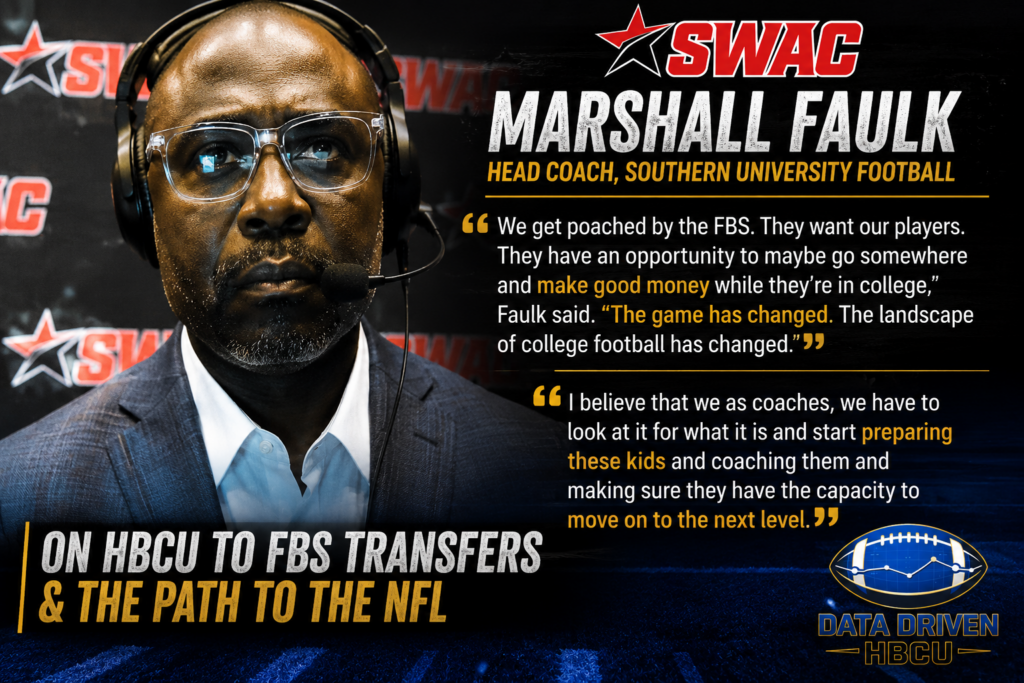
The bluntest version came at SWAC Football Media Day. “I believe that the next level is no longer the NFL,” Marshall Faulk, the Hall of Famer now in his first season as Southern University’s head coach, told reporters. “We get poached by the FBS. They want our players.”
The reaction from HBCU fans was immediate, and much of it was pushback. The NFL has taken players straight off HBCU campuses every year, they argued, so why concede the top rung of the ladder to the transfer portal?
Both sides deserve an answer grounded in data. So we took every FCS-to-FBS transfer tracked by HERO Sports over the last three portal cycles, identified the players who left Division I HBCU programs, and followed each one to see whether the FBS actually served as a bridge to the NFL. Then we compared those results against our own HBCU-to-NFL pipeline dashboard, which tracks every HBCU player who reached an NFL roster, practice squad, or rookie camp across the 2021 through 2026 draft classes.
Faulk is right about the first half of his statement. The second half is where it gets complicated.
The poaching is real
Over the last three transfer cycles, 180 players left Division I HBCU programs for FBS rosters. That is an average of 60 players per year walking out of SWAC, MEAC, and other Division I HBCU locker rooms and into Power 4 and Group of 5 programs.
| Transfer cycle | HBCU players to FBS |
|---|---|
| 2024 | 65 |
| 2025 | 73 |
| 2026 | 42 |
| Total | 180 |
Source: HERO Sports FCS-to-FBS transfer trackers, 2024 through 2026 cycles, filtered to Division I HBCU programs.
No corner of HBCU football has been spared, including Faulk’s new program. Tennessee State lost 22 players to FBS programs over the three cycles, the most of any HBCU. Grambling State lost 18, Florida A&M 16, and Jackson State 11. Southern lost 10, including safety Treylan James to LSU in the most recent cycle. The destinations range from Georgia, LSU, and Oregon to Auburn and down through the Group of 5.
So when Faulk says the FBS wants HBCU players, the transfer ledger backs him completely. This is a real and sustained talent drain, and it is landing hardest on the programs that win.
The money changed what “next level” means
To understand why the drain accelerated, follow the money. Since the House settlement took effect in the summer of 2025, schools that opted in can pay athletes directly from athletic department revenue. The cap was roughly $20.5 million per school in the first year and rises to about $21.3 million for the 2026-27 school year, with power-conference football rosters commanding the largest share of those pools. Third-party deals for a player’s name, image, and likeness add to that.
Division I HBCU programs cannot compete on those terms. Athletic budgets across the SWAC and MEAC are a fraction of what a single power-conference school can now legally pay its football roster in a single year, a gap our financial dashboards document in detail.
That changes the calculation for the player, not just the program. For an all-conference performer at an HBCU, an FBS offer is no longer only a shot at better film and bigger stages. It may be the largest guaranteed payday of his football life. A season or two of revenue sharing and outside deals at an FBS school can exceed what most undrafted free agents ever collect from an NFL contract. For the majority of players who will never be drafted, taking that money is not a detour from the professional dream. In a real sense, it is the professional contract.
Read that way, Faulk’s line lands differently. The FBS has become the next level not because it leads to the NFL, but because for most players it pays like a destination in its own right.
What happened when they got there
The harder question is the one Faulk’s framing implies: is the FBS actually the “next level,” a step on the way up? Or is it simply the last stop?
Of the 180 transfers, 138 left in the 2024 and 2025 cycles and have therefore been through at least one NFL Draft. The 2026 transfers will not be draft eligible until next spring, so they cannot be judged yet.
Among those 138 draft-eligible players, we found 11 with a confirmed NFL opportunity of any kind, meaning a draft selection, an undrafted free agent contract, or a rookie minicamp invitation. That is 8 percent. Exactly one of the 138 was drafted.
| Player | Route | NFL outcome |
|---|---|---|
| Karon Prunty | NC A&T to Wake Forest | Drafted, Round 5, Patriots (2026) |
| Torricelli Simpkins III | NC Central to South Carolina | Undrafted, Saints (2025); made the roster, played 15 games |
| Kisean Johnson | Alabama State to Western Kentucky | Undrafted, Ravens (2025); cut, Packers practice squad |
| Devontae Davis | Jackson State to FAU | Undrafted, Colts (2025); cut |
| Melvin Priestly | Grambling State to Illinois | Undrafted, Lions (2026) |
| Da’Metrius Weatherspoon | Howard to Syracuse | Undrafted, Bills (2026) |
| Anthony Dunn Jr. | Florida A&M to Toledo | Undrafted, Chiefs (2026) |
| Eddie Walls III | Bethune-Cookman to FIU to Houston | Undrafted, Rams (2026) |
| Bryce Phillips | Tennessee State to San Diego State | Undrafted, Chiefs (2026) |
| Caleb Offord | Alabama State to Kennesaw State | Undrafted, Raiders (2026) |
| J’Mari Taylor | NC Central to Virginia | Undrafted, Jaguars (2026) |
Source: 2025 and 2026 NFL Draft results and league undrafted free agent trackers, cross-referenced against HERO Sports transfer lists.
The other 127 players have no confirmed NFL opportunity. That group includes players who did everything the portal promised. Andrew Jones left Grambling State, started at linebacker for Ole Miss, and landed on a national award watch list. James Ash left Florida A&M for Auburn’s defensive line in the SEC. Both went through pro days this spring. Neither has a confirmed NFL deal.
And the one draft pick in the group comes with an asterisk of its own. Karon Prunty began his career at Kansas before arriving at NC A&T, so his fifth-round selection is as much a return to the FBS as a graduation from it.
The pipeline the fans are defending
Here is where the fan pushback finds its footing. Our pipeline dashboard counts 92 HBCU players who reached the NFL in some form across the 2021 through 2026 draft classes. Of those 92, a full 74 went directly from an HBCU campus to an NFL opportunity. No portal, no FBS detour.
| Draft class | Total NFL opportunities | Direct from HBCU | Via transfer | Drafted |
|---|---|---|---|---|
| 2021 | 7 | 7 | 0 | 0 |
| 2022 | 15 | 15 | 0 | 4 |
| 2023 | 11 | 10 | 1 | 1 |
| 2024 | 12 | 11 | 1 | 0 |
| 2025 | 19 | 10 | 9 | 5 |
| 2026 | 28 | 21 | 7 | 3 |
| Total | 92 | 74 | 18 | 13 |
Source: Data Driven HBCU pipeline dashboard, 2021 through 2026 draft classes. NFL opportunities include draft selections, undrafted free-agent signings, practice-squad deals, and rookie minicamp invitations.
The direct route is not shrinking. The 2026 class produced 21 direct-from-campus NFL opportunities, the most of any year we track. For every Travis Hunter who left and became a first-round pick, there have been far more players like Carson Vinson, the Alabama A&M tackle drafted in the fourth round in 2025 without ever leaving, quietly proving scouts still walk through HBCU doors.
Where Faulk has a point, the fans should sit with
But inside those dashboard numbers is a trend that supports Faulk’s larger warning. Look at the draft column. Of the 13 HBCU players drafted since 2021, seven reached the draft through a transfer. And the recent split is stark: all three players drafted in 2026 with HBCU roots, Kevin Coleman Jr., Eric Fuller, and Karon Prunty, left their HBCU programs before draft day. No player has been drafted directly off an HBCU campus since Vinson in 2025, and before him, Isaiah Bolden in 2023.
The direct pipeline is wide, but it mostly flows through the sport’s side doors. Of the 74 players who went straight from HBCU campuses to NFL opportunities, only 10 have reached a 53-man roster at any point. The majority entered as undrafted free agents or camp invitees and were released before the season.
So the honest picture has two layers. The NFL still extends more total opportunities to players coming directly from HBCU campuses than to those who leave. But the draft capital, the guaranteed money and roster security that come with hearing your name called, now flows almost entirely through players who left.
The verdict
Faulk’s quote works as a warning, not as a career map. The FBS clearly wants HBCU players, and for a small group of elite talents it has become the launch pad he describes. For the other 92 percent of players who made the jump over the last two draft cycles, the FBS was not a step toward the NFL. It was the destination, and thanks to revenue sharing, it was likely the biggest football paycheck they will ever cash.
The numbers suggest a harder truth than either side of the argument wants: leaving an HBCU does not meaningfully improve most players’ NFL odds, and staying does not erase the draft-day gap. What the portal has done is separate the two things the phrase “next level” used to bundle together. The opportunity to reach the NFL still runs through HBCU campuses. The draft stock, increasingly, does not.
The 42 players who left in the 2026 cycle and the underclassmen from earlier cycles who are still on FBS rosters will add new evidence soon enough. We will continue to track both routes on the pipeline dashboard.