
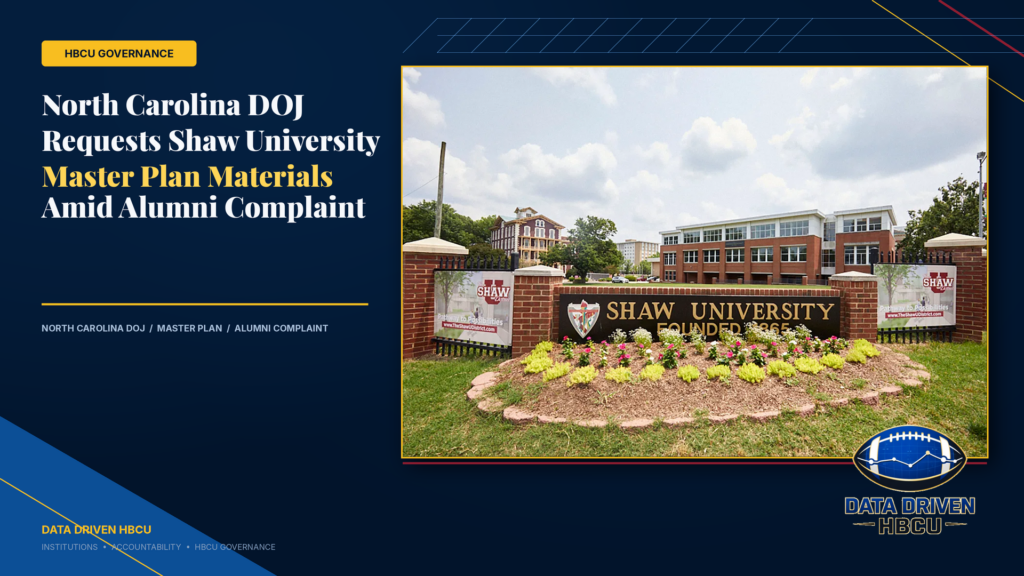
The North Carolina Attorney General’s Office is reviewing the complaint the Save Our Shaw coalition filed against Shaw University. It has asked the coalition for more information, and Shaw says the office has requested materials related to the university’s campus master plan.
Data Driven HBCU obtained the 208-page complaint and the office’s emails with the coalition through a public records request to the North Carolina Department of Justice.
The records show the coalition’s filing reached the office in August, seven weeks before the group announced it at a press conference across from campus on Oct. 1. By early September, an assistant attorney general had listened to a recording the coalition submitted of a conversation with the secretary of Shaw’s board of trustees and asked to speak with the group about it.
The office has not said what, if anything, it will do. In writing, it said it is still deciding which of the complaint’s allegations fall within its jurisdiction.
In response to Data Driven HBCU’s request for comment, Shaw University provided an Oct. 1 message from President Paulette Dillard to the Shaw community.
The Timeline
| Date | Event |
|---|---|
| Aug. 5 | Save Our Shaw signs its complaint |
| Aug. 12 | The Attorney General’s Office receives it |
| Aug. 31 | The coalition asks the office to consider interim measures to protect Shaw’s property and endowment. |
| Sept. 1 | The office replies that it is still reviewing the complaint |
| Sept. 4 | The coalition submits a recording and transcript of a conversation with board secretary Dr. Donell Lewis. |
| Sept. 4 | After listening to the recording, the office asks to speak with the coalition and proposes a call for Sept. 10 |
| Oct. 1 | The coalition announces the complaint at a press conference, and Dillard says the Department of Justice has requested materials related to the master plan. |
What the Attorney General’s Office Has Said
Assistant Attorney General Gabriel Jimenez-Medina of the Finance, Charities, and Utilities Section in the department’s Consumer Protection Division is handling the complaint.
On Sept. 1, he wrote to the coalition that “given the scope of the initial submission, we are still reviewing it to determine what allegations fall within our jurisdiction and whether further inquiry or action is warranted.”
The coalition asked for an update on the review and whether the office would consider seeking a court injunction. He declined to say.
“As a law enforcement agency, we do not provide regular updates as to the status of an ongoing review or investigation,” he wrote. “Nor do we forecast what our future actions may be.”
Three days later, after the coalition sent its recording, he wrote back: “After listening to the audio, our Office has some additional questions involving the conversation recorded.” He asked whether anyone from the group could speak with the office the following week and proposed a call on Thursday, Sept. 10. The records do not show whether that call took place.
In an Aug. 31 email, coalition member Kesha Monk wrote that Jimenez-Medina had told her by phone that the matter fell within the office’s jurisdiction and was awaiting his supervisor’s approval. His written reply the next day did not repeat that. It said the office was still determining which allegations fall within its jurisdiction.
What Shaw Has Said
Dillard’s Oct. 1 message, posted on the university’s website the day of the press conference, is the statement Shaw provided in response to Data Driven HBCU’s request for comment.
“The North Carolina Department of Justice has requested materials related to the Master Plan, and the University is coordinating its response,” she wrote.
The message describes the complaint as raising “concerns about University governance, the stewardship of charitable assets and institutional funds, and the campus Master Plan.” It does not respond to any specific allegation.
“Our responsibility is to support our students, steward the University’s resources, and sustain ShawU’s educational mission,” Dillard wrote. “That responsibility includes listening to concerns and addressing them with care and accountability.”
She also wrote that “the concerns expressed by the Save Our Shaw Coalition do not reflect the views of every alumnus.”
The message does not say when the department made its request, what materials it asked for, or whether the university has provided them. The emails Data Driven HBCU obtained are between the office and the coalition and do not include any correspondence with Shaw.
What the Coalition Asked For
The complaint opens with a two-page cover letter titled “Emergency Request for Immediate Review and Protective Action.” It argues that Shaw’s property and endowment “may be at imminent risk of further encumbrance, transfer, lease, or sale” before the state can review the university’s actions.
The coalition asked the office to conduct an expedited review, open a formal inquiry, and use any authority it has to preserve the status quo while it reviews the complaint.
The letter also explains why the group went to the state. Alumni previously sued in federal court, but the court dismissed the case because it found alumni lacked standing to bring claims on the university’s behalf. The coalition wrote that the Attorney General, as the state’s protector of charitable assets, is “uniquely positioned” to act.
In her Aug. 31 email, Monk wrote that the filing was not a consumer complaint or a request for mediation. She asked the office to consider interim measures to prevent the sale or further encumbrance of Shaw’s real estate, more borrowing against university property and further use of donor-restricted funds outside their restrictions while the review is underway.
“We are not asking the Office to reach conclusions regarding our allegations without allowing Shaw University an opportunity to respond,” she wrote. “We are asking whether steps should be taken to preserve the status quo and protect potentially affected charitable assets while that response and the Attorney General’s review take place.”
What the Complaint Alleges
The complaint is organized into eight issues, each with its own exhibits.
| Issue | What the coalition asks the office to review |
|---|---|
| 1. Notice of property transactions | Whether Shaw gave the Attorney General required advance notice before property sales, transfers and its 2025 loan |
| 2. Board fiduciary duties | Whether trustees acted with appropriate care in approving property deals, debt and redevelopment |
| 3. Use of endowment funds | Whether gifts meant for the endowment were used in line with donor restrictions |
| 4. Management of endowment funds | Whether the endowment was managed prudently |
| 5. Conflicts of interest | Whether any trustee conflicts were disclosed and handled properly |
| 6. Board quorum and voting | Whether major votes had a quorum, how proxy votes were used, and how four trustees were appointed |
| 7. Corporate records | Whether Shaw keeps and provides required board minutes and records |
| 8. Historic buildings | Whether the campus redevelopment protects Shaw’s historic buildings |
State law requires a charitable corporation to notify the Attorney General at least 30 days before it sells, leases, exchanges or otherwise disposes of all, or a majority of, its property outside the usual course of its activities, unless the office waives the requirement. The complaint argues that Shaw’s property sales since 2018, together with the June 2025 deed of trust that pledged campus property as collateral for a loan of up to $20 million from Self-Help Ventures Fund, raise the question of whether that threshold has been reached.
Whether pledging property as collateral counts as a disposition under that law is a legal question the complaint raises but does not settle.
The complaint also cites public statements about the campus redevelopment. It quotes Kevin Sullivan, Shaw’s vice president of real estate, as saying at a public meeting, “We believe all of Shaw’s historic buildings should be moved and put somewhere where they can be celebrated.” It notes that President Paulette Dillard said at a June 4 town hall that the board had approved a campus master plan, which the complaint says the university has not released. The master plan is the one part of the complaint Shaw has said the Department of Justice asked about.
The day after the coalition’s press conference, Shaw announced a federal award for one of its historic buildings. On Oct. 2, the university said the National Park Service had awarded it $750,000 through the Historic Preservation Fund’s HBCU program for Phase II of a rehabilitation of the historic windows at Tyler Hall.
| Tyler Hall award budget | Amount |
|---|---|
| Construction | $645,610 |
| Contractual services | $65,000 |
| Indirect costs | $31,390 |
| Other project costs | $8,000 |
| Total | $750,000 |
The award runs from Oct. 1, 2026, through Sept. 30, 2030. The university said the work will focus on repairing and keeping Tyler Hall’s historic windows, frames and sash, with replacement allowed only when repair is not feasible and the Park Service approves.
The award comes with federal conditions. Before any construction begins, Shaw must complete historic preservation and environmental reviews and select consultants and contractors through federal procurement rules. It must also file annual financial and performance reports and complete a required preservation easement or covenant.
“Preserving Shaw University’s historic campus is an investment in our legacy, our students and the future of ShawU,” Dillard said in announcing the award.
The announcement describes the award as part of the university’s commitment to stewarding its historic campus “while advancing the institution’s long-term vision for its facilities and the ShawU District.” It does not say how Tyler Hall fits into the master plan.
The Endowment
Two of the complaint’s eight issues focus on Shaw’s endowment, and both draw on the university’s own audit.
That audit shows $1,369,507 in endowment gifts in 2023-24, and $815,425 in 2024-25 were used for operations instead of being invested. Shaw records the money as a loan from its endowment, with a balance of $2,184,932 at the end of June 2025 and a plan to repay it over seven years at 7 percent interest.
The audit also shows that in March 2025, the board authorized a line of credit of up to $14 million from the endowment to meet urgent cash needs. Endowment funds that had fallen below the value of their original gifts totaled about $3.06 million.
What Shaw University’s Own Records Show as Alumni Go to the Attorney General takes a deeper look at those figures and the university’s debt.
The complaint says the coalition found no public record of donor consent or court approval for using restricted funds, if such approval was required.
The Recording
On Sept. 4, the coalition sent the office an audio recording and transcript of a conversation between Save Our Shaw founder Eugene Myrick and Dr. Donell Lewis, who was then and remains secretary of Shaw’s board and a member of its executive committee. The emails do not say when the conversation took place.
Data Driven HBCU has not heard the recording. In the coalition’s description, Lewis says he had not received information about the endowment and did not believe the board had received accurate information. The coalition says he also discusses the board’s investment committee, the firms he understood to be managing endowment assets, and questions he had raised about how the university farm is treated in relation to the endowment.
Media inquiries to Lewis, as a trustee, go through the university. Its statement does not address the recording.
That recording prompted the office’s request to talk with the coalition.
The complaint mentions a second recording of a current trustee discussing the board’s use of proxy voting, which the coalition did not submit but offered to provide upon request. In its email, the coalition said it has more audio and video recordings it may provide “selectively.”
What the Complaint Does and Does Not Show
Much of the complaint rests on what the coalition says it could not find. For several issues, it says it found no public record of notice to the Attorney General, donor consent, conflict disclosures, quorum counts, or board minutes.
Its own exhibits note the limit of that approach. “This statement is not intended to represent that such records do not exist,” several of them read. “Rather, it reflects only that the Coalition was unable to identify publicly available records documenting these matters after conducting its search.”
The complaint does not identify a specific trustee conflict of interest. It asks the office to obtain board records showing whether any exist.
Some of the statutory language the complaint quotes also does not match the text of the laws it cites.
What Comes Next
The Attorney General’s Office has not said whether it will take any action, and it has not said what it might do.
The records leave several questions open:
- Did the office speak with the coalition on Sept. 10?
- What master plan materials did the office request from Shaw, and has the university provided them?
- Which of the complaint’s eight issues does the office consider within its jurisdiction?
- Has Shaw ever notified the office of a property transaction or received a waiver of the notice requirement?
- Will the board release the master plan publicly, and how does Tyler Hall fit into it?
- What did the board know about the endowment, and when?
For now, the review continues out of public view.


